![s[3]decode](https://s3decode.com/wp-content/uploads/2026/05/logo-s3decode.png)
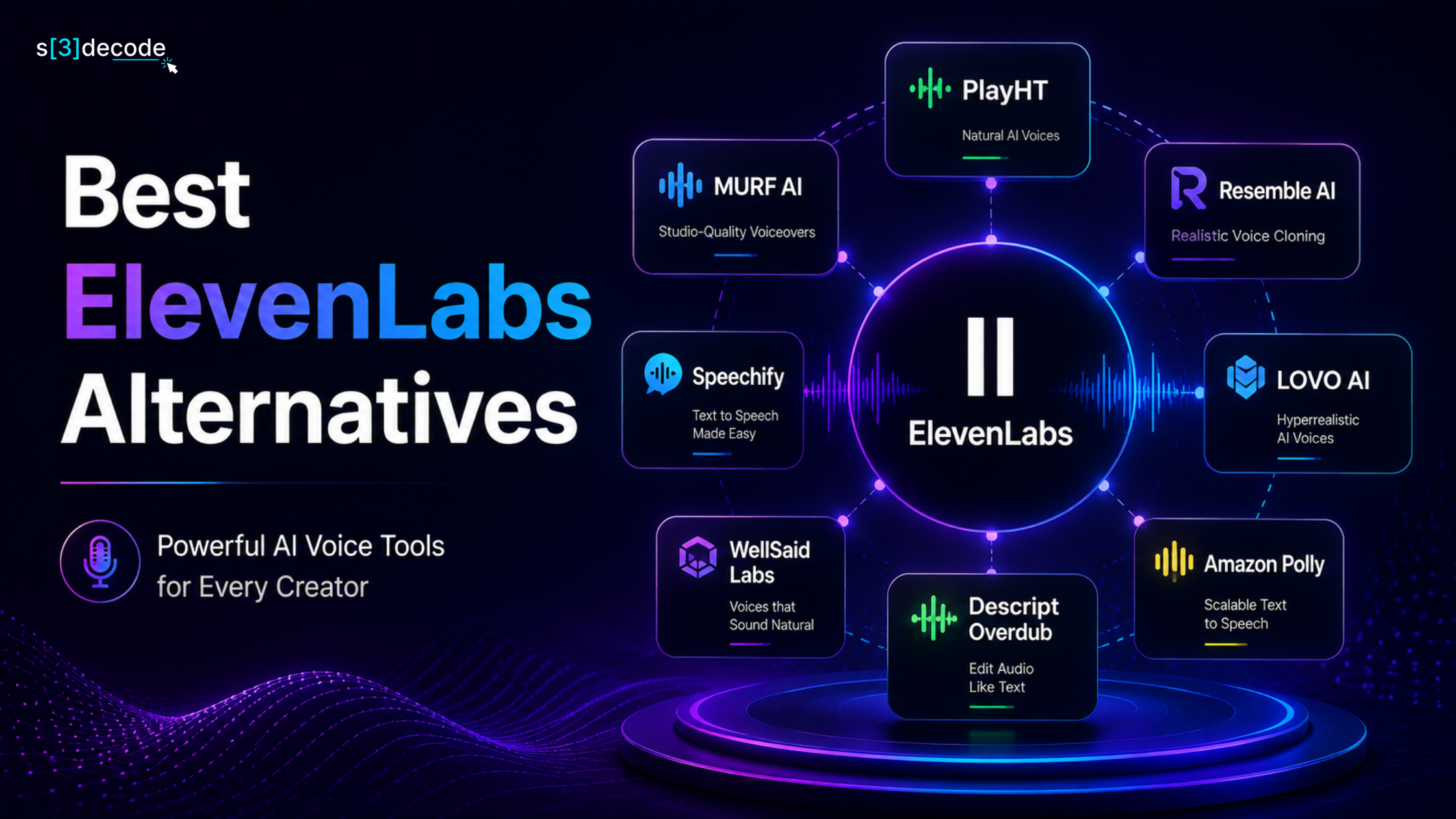
You have a script ready, your video is almost finished, and then you hit the same problem: you need a realistic voiceover, but hiring a professional voice actor for every piece of content is expensive and slow.
AI voice generators solve that problem. With the right tool, you can turn a script into a natural-sounding voiceover within minutes.
But there is another problem. ElevenLabs is not the only option anymore.
In 2026, the AI voice market includes traditional text-to-speech platforms, voice-cloning tools, developer APIs, open-source models, and complete AI phone-agent platforms. Some alternatives are cheaper than ElevenLabs, while others offer better tools for enterprise applications, real-time conversations, multilingual content, or self-hosted deployments.
Some Important Facts to know
One 2026 market analysis estimates that the global AI voice generator market could reach $7.7 billion in 2026, up from $3.6 billion in 2023, with a projected 29.5% CAGR through 2030. Another 2026 estimate puts the broader text-to-speech market at $5.7 billion in 2026, with a projected 22.4% annual growth rate through 2035.
At the same time, ElevenLabs remains a major player, but its pricing and capabilities aren’t necessarily the perfect fit for every user. Its current API pricing starts at $0.05 per 1,000 characters for Flash/Turbo TTS and $0.10 per 1,000 characters for Multilingual v2/v3. That’s where the Best ElevenLabs Alternatives come in.
For example, a YouTube creator may want an easy voiceover editor, while a SaaS company may need an API that can generate thousands of conversations every day. A marketing team may care about commercial rights and voice consistency, whereas a customer-service company may need an AI agent that can actually answer phone calls.
In this guide, we compare the top ElevenLabs alternatives in 2026, including pricing, key features, pros, cons, and the type of business or creator each platform suits best.
Quick Comparison: Best ElevenLabs Alternatives
| Tool | Best For | Main Strength |
|---|---|---|
| Murf AI | Business voiceovers | Voiceover creation and editing |
| LOVO AI | Voice + video | AI video production |
| Speechify | TTS and dubbing | Large voice selection |
| WellSaid Labs | Enterprise voiceovers | Professional business narration |
| PlayAI | Voice APIs | Developer applications |
| Resemble AI | Voice cloning | Custom voices |
| Cartesia | Real-time AI | Low-latency voice |
| Deepgram | Developers | Speech infrastructure |
| Smallest.ai | Fast TTS | Real-time generation |
| Azure AI Speech | Enterprise | Languages and cloud infrastructure |
| Fish Audio | Expressive TTS | Expressive voices |
| Chatterbox | Open source | Self-hosted voice AI |
| Google Gemini TTS | AI applications | Speech + AI reasoning |
| Murf Falcon 2 | Voice agents | Low-latency TTS |
| Amazon Polly | Cloud TTS | AWS integration |
| OpenAI | AI voice apps | Conversational AI |
| Vapi | Voice agents | Developer flexibility |
| Synthflow | No-code agents | Business phone automation |
| Retell AI | AI phone agents | Real-time conversations |
| Air AI | Sales calls | Automated sales conversations |
| Cognigy | Enterprise agents | Contact-center automation |
| PolyAI | Customer service | Conversational voice AI |
| Amazon Connect | Contact centers | AWS contact-center infrastructure |
| Google Cloud TTS | Cloud applications | Scalable speech APIs |
| Hume AI | Emotional voice AI | Expressive conversational speech |
| WellSaid Labs API | Enterprise developers | Branded voice workflows |
What Is ElevenLabs?
ElevenLabs is an AI voice platform designed for generating realistic speech from text, voice cloning, dubbing, sound effects, and increasingly complete conversational AI experiences.
Its current plans start with a free tier, while the Starter plan is $6/month, Creator is $22/month, and Pro is $99/month. The Creator plan includes professional voice cloning, while higher plans provide larger credit allowances and additional capabilities.
ElevenLabs remains an important benchmark because it combines:
- Natural-sounding AI voices
- Voice cloning
- Multilingual speech
- Dubbing
- Text-to-speech APIs
- Voice design
- Developer tools
- AI voice agents
However, the best platform depends on what you need.
Why Look for ElevenLabs Alternatives in 2026?
ElevenLabs is powerful, but it is not automatically the right choice for every project. Here are some common reasons to consider alternatives.
1. You want lower or more predictable costs
Different platforms charge by characters, minutes, tokens, credits, calls, or monthly subscriptions. For high-volume applications, a pay-as-you-go API can sometimes make more financial sense than a creator subscription.
2. You need an AI phone agent
A traditional TTS tool generates speech. A voice-agent platform can listen, reason, respond, call APIs, schedule appointments, and handle phone conversations. That is a completely different use case.
3. You need enterprise infrastructure
Large companies may need:
- SSO
- Security controls
- Data retention policies
- Compliance
- Contact-center integrations
- Custom SLAs
- Regional deployment
Cloud platforms such as Azure and AWS can be more suitable in those situations.
4. You want open-source AI
Developers may prefer to run a voice model themselves instead of depending entirely on a hosted service.
That is where tools such as Chatterbox become interesting.
5. You need extremely low latency
Voice agents cannot afford long pauses. Tools such as Cartesia, Deepgram, Smallest.ai, and Murf Falcon focus heavily on fast speech generation.
Here are the Best ElevenLabs Alternatives in 2026
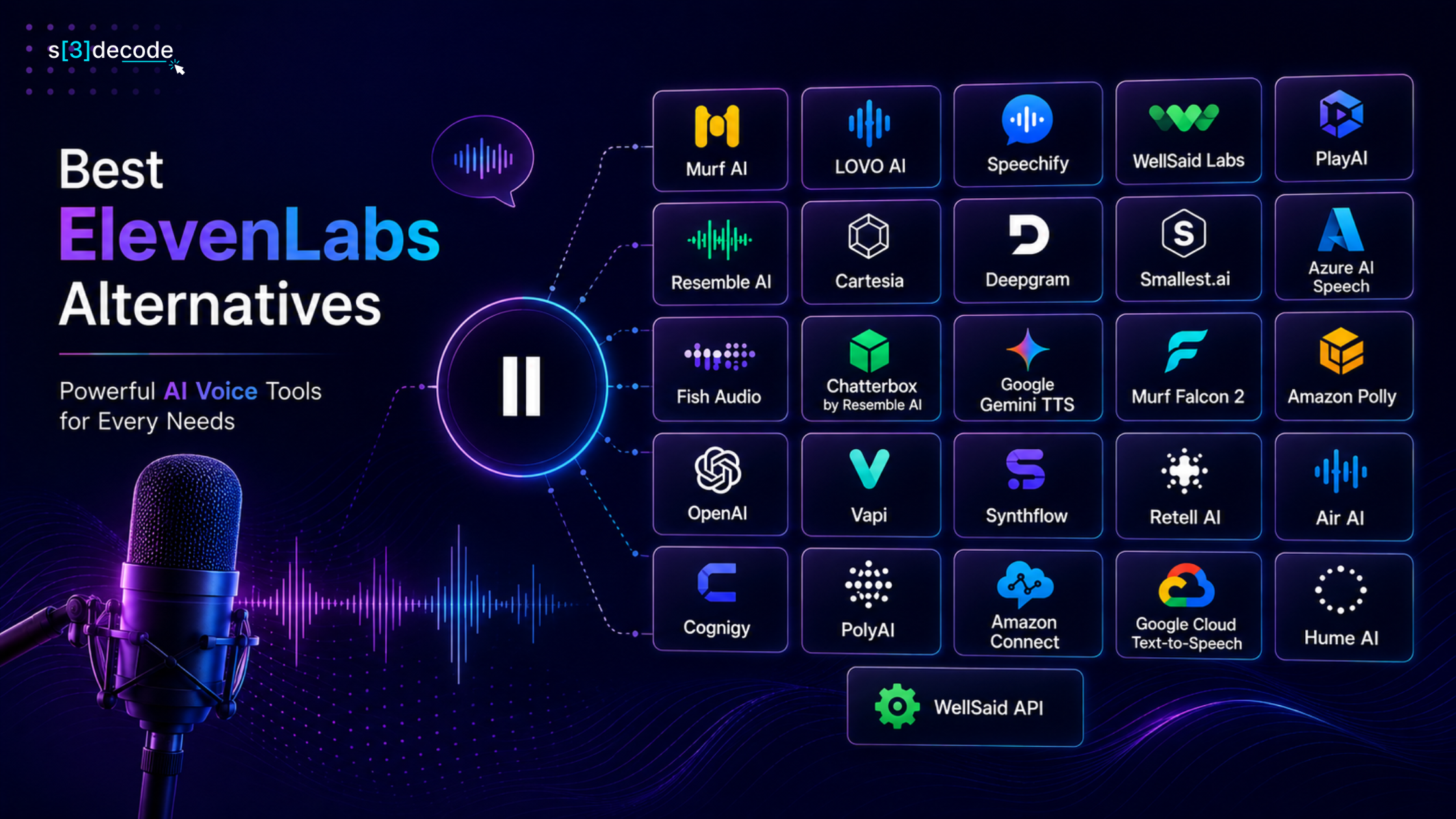
1. Murf AI
Murf AI is one of the most recognizable ElevenLabs competitors for businesses. Rather than focusing only on raw text-to-speech generation, it provides an environment where users can create, edit, and produce complete voiceovers.
That makes it particularly useful for marketing teams, training departments, agencies, and businesses creating presentations or explainer videos.
| Key Features | Pros | Cons |
|---|---|---|
| • AI voice generation • Large voice library • Multiple languages and accents • Voice cloning • Voiceover editor • Pronunciation controls • Voice changer • API | • Easy for beginners • Strong business workflow • Useful editing tools • Good for presentations and training • API available | • Advanced features require higher plans • Less developer-focused than cloud speech platforms • Heavy usage can become e |
Pricing: $19/month Creator plan when billed annually; Business starts around $66/month when billed annually.
Pricing model: Subscription
Best for: Businesses, marketers, agencies, educators, and teams producing professional voiceovers.
2. LOVO AI
LOVO AI takes a broader approach by combining AI voice generation with video creation. Its Genny platform allows users to create voiceovers while working on video content, making it convenient for marketing and social media teams.
| Key Features | Pros | Cons |
|---|---|---|
| • AI voice generation • Voice cloning • Video editor • Dubbing • Subtitles • Multilingual voices • AI content tools | • Voice and video in one platform • Beginner-friendly • Good for marketing content • Useful for social media production | • More than you need if you only require TTS • Advanced usage can become expensive • Less focused on developer infrastructure |
Pricing: $24/month Pro when billed annually; higher plans available
Pricing model: Subscription
Best for: Content creators, marketers, agencies, educators, and small businesses.
3. Speechify
Speechify is particularly well known for text-to-speech, but its product range now extends into professional voice generation, dubbing, voice cloning, and related audio tools.
Its large voice library makes it worth considering if voice variety and multilingual content are important to your workflow.
| Key Features | Pros | Cons |
|---|---|---|
| • Large AI voice library • Text-to-speech • Voice cloning • Dubbing • Voice changer • Multilingual speech • API • Studio tools | • Large selection of voices • Easy to use • Strong accessibility use cases • Useful for dubbing and narration | • Different products have different pricing • Premium features can increase costs • Not primarily designed for complex voice-agent infrastructure |
Pricing: $29/month Premium
Pricing Model: Subscription
Best for: Publishers, educators, creators, audiobook projects, and businesses producing narrated content.
4. WellSaid Labs
WellSaid Labs focuses heavily on professional and enterprise voice production. Its platform is particularly useful for organizations producing e-learning, employee training, product education, and corporate communications.
| Key Features | Pros | Cons |
|---|---|---|
| • Professional AI voices • Voiceover editor • Team collaboration • Commercial usage • API • Enterprise controls • Branded voice workflows | • Professional business focus • Good for corporate content • Collaboration features • Consistent voice production | • Less suitable for casual creators • Enterprise plans can be expensive • Less focused on consumer-style voice cloning |
Pricing: Starter $10/month annually; Pro $33/month annually; Business $160/user/month annually.
Pricing Model: Subscription
Best for: Enterprises, training departments, e-learning companies, and corporate marketing teams.
5. PlayAI
PlayAI is particularly relevant when you want to integrate AI-generated speech into an application rather than simply create a voiceover manually.
Its developer-oriented approach makes it a potential alternative for SaaS products, AI applications, and conversational experiences.
| Key Features | Pros | Cons |
|---|---|---|
| • Text-to-speech • Voice cloning • Streaming • Multilingual voices • API • Conversational AI • Custom voices | • Developer-friendly • Voice cloning • Suitable for applications • Supports conversational use cases | • Less focused on video editing • Advanced features require technical knowledge • Costs should be evaluated based on usage |
Pricing: Custom/usage-based pricing for API and business use
Pricing Model: Usage/custom
Best for: Developers, SaaS businesses, AI startups, and voice application builders.
6. Resemble AI
Resemble AI is a particularly strong choice if custom voice creation is more important to you than having the largest possible library of ready-made voices.
It supports voice cloning, speech-to-speech conversion, custom voices, and APIs for developers.
| Key Features | Pros | Cons |
|---|---|---|
| • Voice cloning • Custom voice creation • TTS • Speech-to-speech • Voice conversion • API • Real-time voice capabilities | • Strong cloning capabilities • Developer-focused • Custom branded voices • Useful for applications | • More technical than creator platforms • Usage-based pricing can increase with scale • Voice cloning requires appropriate consent and rights |
Pricing: Starts at $0; API usage-based. Creator plans have historically started around $19/month, but current product pricing has shifted toward its broader AI platform.
Pricing Model: Usage/custom
Best for: AI startups, game developers, enterprises, and companies creating custom branded voices.
7. Cartesia
Cartesia is one of the more interesting ElevenLabs alternatives for real-time applications. Instead of focusing primarily on traditional voiceover production, it emphasizes low-latency speech for conversational AI and voice agents.
| Key Features | Pros | Cons |
|---|---|---|
| • Sonic TTS models • Real-time streaming • Voice cloning • Multilingual speech • Voice-agent support • API • Low-latency generation | • Strong real-time performance • Good conversational experience • Developer-friendly • Suitable for AI agents | • Overkill for basic narration • Requires technical integration • Usage costs need monitoring |
Pricing: $5/month Pro plan; API usage varies by model.
Pricing Model: Subscription + usage
Best for: AI assistants, SaaS products, voice agents, and real-time applications.
8. Deepgram
Deepgram approaches the speech market from an infrastructure perspective. Its platform includes speech-to-text, text-to-speech, and tools for building voice agents.
That makes it a particularly strong option for developers who need speech capabilities inside their own applications.
| Key Features | Pros | Cons |
|---|---|---|
| • Aura TTS • Speech-to-text • Streaming • Voice Agent API • Pronunciation controls • Real-time processing • Developer APIs | • Strong developer ecosystem • TTS and STT in one platform • Good for real-time applications • API-focused | • Not beginner-oriented • Limited traditional voiceover editing • Requires development work |
Pricing: Aura-2: $0.030/1,000 characters; Aura-1: $0.015/1,000 characters.
Pricing Model: Usage-based
Best for: Developers, SaaS companies, AI startups, and voice applications.
9. Smallest.ai
Smallest.ai focuses heavily on speed. Its Lightning TTS technology is designed for applications where speech needs to be generated quickly, particularly AI agents and conversational systems.
| Key Features | Pros | Cons |
|---|---|---|
| • Lightning TTS • Real-time generation • Voice cloning • Multilingual speech • Speech-to-text • Speech-to-speech • Voice-agent APIs | • Very fast generation • Strong real-time focus • Developer-friendly • Useful for AI agents | • Newer platform • Less focused on traditional voiceovers • Advanced features require API integration |
Pricing: Around $0.175/1M characters for some Lightning TTS usage tiers.
Pricing Model: Usage-based
Best for: Developers, AI startups, voice agents, and real-time applications.
10. Azure AI Speech
Microsoft’s Azure AI Speech is a powerful alternative when you need speech services inside an enterprise cloud environment. It supports TTS, speech recognition, translation, custom voices, SSML, and a large range of languages and voice variants.
| Key Features | Pros | Cons |
|---|---|---|
| • Neural TTS • Speech recognition • Custom neural voices • SSML • Speech translation • 400+ voices • 140+ languages and variants • Azure integration | • Excellent language coverage • Enterprise infrastructure • Strong APIs • Microsoft ecosystem integration | • Complex for beginners • Usage-based pricing • Less creator-focused than ElevenLabs |
Pricing: Neural TTS starts around $16/1M characters for standard neural voices; free tier available for some services.
Pricing Model: Usage-based
Best for: Enterprises, global applications, developers, and Microsoft Azure customers.
11. Fish Audio
Fish Audio focuses on expressive speech and voice cloning. It is worth considering if you want generated speech to convey more personality rather than simply produce clean narration.
| Key Features | Pros | Cons |
|---|---|---|
| • Expressive TTS • Voice cloning • Multilingual speech • Custom voices • API • Voice customization | • Expressive voices • Voice cloning • Developer API • Useful for creative applications | • Smaller enterprise ecosystem • Pricing and models can change • Licensing should be checked for commercial projects |
Pricing: API pricing around $15/1M UTF-8 bytes for supported TTS usage.
Pricing Model: Usage-based
Best for: Creators, developers, AI startups, and users looking for expressive voices.
12. Chatterbox by Resemble AI
Chatterbox is different from most tools on this list because it is an open-source model rather than simply another hosted SaaS platform.
It gives developers more control over how speech generation is deployed, including the possibility of self-hosting.
| Key Features | Pros | Cons |
|---|---|---|
| • Open-source TTS • Voice cloning • Multilingual models • Emotion control • Self-hosting • Local deployment • Developer customization | • Greater control • Open-source • Self-hosting possible • Useful for experimentation • No traditional SaaS subscription | • Requires technical knowledge • You manage infrastructure • GPU costs can become significant • Less convenient for beginners |
Pricing: Free/open source model; infrastructure/GPU costs apply when self-hosting
Pricing Model: Open source
Best for: Developers, researchers, AI startups, and teams wanting control over their speech stack.
13. Google Gemini TTS
Google’s Gemini ecosystem is particularly interesting because speech generation can be combined with AI reasoning and multimodal capabilities.
That makes it different from a conventional voiceover generator. You can use it when an application needs to understand information, generate a response, and then speak that response.
| Key Features | Pros | Cons |
|---|---|---|
| • Gemini TTS • Native audio capabilities • Real-time interaction • Multiple voices • Multimodal AI • Live API • Developer API | • Combines speech and AI reasoning • Strong conversational potential • Google ecosystem integration • Useful for AI applications | • Not a traditional voiceover editor • API pricing can be complex • Some capabilities may depend on model availability |
Pricing: Gemini 2.5 Flash TTS: $0.50/1M text tokens + $10/1M audio output tokens.
Pricing Model: Token-based
Best for: AI startups, developers, SaaS companies, and conversational AI applications.
14. Murf Falcon 2
Murf Falcon 2 is Murf’s next-generation text-to-speech model designed for fast, natural-sounding speech generation and real-time applications. It is particularly relevant for developers building conversational AI, voice agents, and applications where response speed matters.
| Key Features | Pros | Cons |
|---|---|---|
| • Low-latency TTS • Real-time streaming • Natural-sounding speech • API access • Conversational AI support • Multilingual capabilities • Voice-agent applications | • Designed for fast response times • Suitable for conversational applications • Developer-friendly API • Useful for real-time voice agents | • Less suitable for traditional voiceover editing • Primarily API-focused • Requires technical integration for custom applications |
Pricing: Usage-based/API pricing; contact Murf for current Falcon 2 commercial pricing.
Pricing Model: Usage-based
Best for: Developers, AI startups, SaaS platforms, conversational AI, and real-time voice applications.
15. Amazon Polly
Amazon Polly is one of the most established alternatives to ElevenLabs. Instead of targeting creators first, it focuses on providing scalable speech infrastructure through AWS.
| Key Features | Pros | Cons |
|---|---|---|
| • Standard TTS • Neural TTS • Generative TTS • Long-form speech • Speech Marks • API • AWS integration • Pay-as-you-go pricing | • Highly scalable • Strong AWS integration • Usage-based pricing • Suitable for large applications | • Requires technical setup • Limited creator-oriented editing • Voice experience differs from specialist platforms |
Pricing: Standard: $4/1M characters; Neural: $16/1M characters.
Pricing Model: Usage-based
Best for: Developers, SaaS companies, enterprises, and AWS users.
16. OpenAI
OpenAI is worth considering when voice is only one component of a larger AI product.
Instead of simply converting a finished script into audio, developers can build applications where users speak to an AI, the system reasons about the request, uses tools, and responds with speech.
| Key Features | Pros | Cons |
|---|---|---|
| • Text-to-speech • Speech recognition • Real-time voice • AI reasoning • Tool calling • Multimodal AI • Developer APIs | • Strong AI ecosystem • Speech + reasoning in one stack • Excellent for conversational products • Flexible API capabilities | • Not a direct replacement for every voiceover workflow • Usage-based costs • Developers may need to build the application layer |
Pricing: TTS pricing varies by model; API is usage-based.
Pricing Model: Usage-based
Best for: AI startups, SaaS products, developers, and conversational applications.
17. Vapi — Best for Developer Voice Agents
Vapi is not really a traditional TTS competitor. Instead, it provides infrastructure for developers who want to build AI voice agents.
You can connect speech recognition, language models, TTS providers, telephony, and business tools into a voice-agent workflow.
| Key Features | Pros | Cons |
|---|---|---|
| • Voice-agent APIs • Telephony • TTS integrations • Speech recognition • LLM integrations • Tool calling • Webhooks • Call workflows | • Highly flexible • Developer control • Supports multiple providers • Useful for custom AI agents | • Not a voiceover generator • Technical setup required • Total cost includes multiple components |
Pricing: $0.05/minute Vapi hosting + underlying provider costs.
Pricing Model: Usage-based
Best for: Developers, SaaS startups, and businesses building custom voice agents.
18. Synthflow
Synthflow is designed for businesses that want AI phone agents without building the entire infrastructure themselves.
Its no-code approach makes it more accessible to sales and operations teams than developer-first platforms.
| Key Features | Pros | Cons |
|---|---|---|
| • No-code voice agents • Inbound calls • Outbound calls • CRM integrations • Appointment scheduling • Workflow automation • Analytics | • Easy for non-developers • Strong business workflows • Useful for phone automation • CRM integrations | • Not a traditional TTS tool • Call volume affects costs • Complex deployments can become expensive |
Pricing: Custom/sales-led pricing; enterprise contracts currently start at $30,000/year.
Pricing Model: Custom
Best for: Small businesses, agencies, sales teams, and operations departments.
19. Retell AI
Retell AI focuses on real-time AI phone conversations. It provides tools for building, testing, monitoring, and deploying voice agents.
For businesses automating customer support or sales calls, this type of platform may be more useful than a traditional ElevenLabs-style TTS service.
| Key Features | Pros | Cons |
|---|---|---|
| • Real-time voice agents • Phone calls • Call analytics • Transcripts • Testing tools • Webhooks • APIs • Knowledge bases | • Strong voice-agent focus • Production-oriented • Developer-friendly • Useful call analytics | • Not suitable for ordinary narration • Multiple components affect total cost • Requires testing before large-scale deployment |
Pricing: $0.07–$0.31/minute for AI voice agents; $10 free credits.
Pricing Model: Usage-based
Best for: AI startups, sales teams, customer-support teams, and businesses automating calls.
20. Air AI
Air AI takes the voice-agent concept in a sales-oriented direction. Instead of generating narration, it focuses on automated phone conversations and sales workflows.
| Key Features | Pros | Cons |
|---|---|---|
| • AI phone calls • Outbound calling • Sales automation • Lead qualification • Automated conversations • Customer interactions | • Strong sales focus • Automates repetitive calls • Built around phone conversations | • Not a traditional TTS platform • Not suitable for creators • Businesses must consider applicable calling regulations |
Pricing: Business pricing depends on the deployment and should be checked directly with the provider.
Pricing Model: Custom
Best for: Sales teams and businesses automating outbound calls.
21. Cognigy
Cognigy is designed for enterprise conversational AI and customer-service automation. It supports voice and digital channels and integrates with contact-center workflows.
| Key Features | Pros | Cons |
|---|---|---|
| • Enterprise AI agents • Voice automation • Digital channels • Contact-center integrations • Workflow automation • Agent orchestration • Analytics | • Strong enterprise capabilities • Complex workflows supported • Contact-center focused • Built for large organizations | • Overkill for creators • Implementation can take time • Enterprise/custom pricing |
Pricing: Enterprise/custom pricing.
Best for: Large organizations, contact centers, banks, telecom companies, and enterprise customer-service teams.
22. PolyAI
PolyAI specializes in customer-service conversations rather than simple text-to-speech. Its technology is designed to let businesses automate natural voice interactions.
| Key Features | Pros | Cons |
|---|---|---|
| • Conversational voice AI • Customer-service automation • Voice assistants • Contact-center integration • Natural-language conversations • Enterprise deployment | • Strong enterprise focus • Designed for natural conversations • Suitable for complex service workflows • Contact-center integration | • Not designed for content creators • Enterprise-oriented • Custom pricing |
Pricing: Enterprise/custom pricing.
Best for: Contact centers, financial services, telecom, travel, and large customer-service organizations.
23. Amazon Connect
Amazon Connect combines cloud contact-center infrastructure with AI capabilities. It is therefore a much broader solution than an ElevenLabs-style TTS platform.
For an organization already using AWS, however, it can be a compelling option.
| Key Features | Pros | Cons |
|---|---|---|
| • AI voice agents • Contact-center infrastructure • Telephony • Speech recognition • TTS • Agentic self-service • Analytics • AWS integrations | • Strong AWS ecosystem • Highly scalable • Contact-center functionality • Suitable for enterprise deployments | • Complex for beginners • Costs depend on AWS architecture • Not intended for traditional voiceovers |
Pricing: $0.038/minute for Connect Customer voice, plus applicable telephony charges.
Pricing Model: Usage-based
Best for: Enterprises, contact centers, and organizations already using AWS.
24. Google Cloud Text-to-Speech
Google Cloud Text-to-Speech is another developer-oriented alternative. It is particularly useful when you need to add speech generation to a website, mobile application, SaaS platform, or other software.
| Key Features | Pros | Cons |
|---|---|---|
| • Neural TTS • Multilingual speech • SSML • API • Google Cloud integration • Usage-based pricing • Developer tools | • Highly scalable • Strong cloud integration • Good for applications • Flexible API | • Technical setup required • Less suitable for creators • Pricing varies by model and usage |
Pricing: Pricing varies by voice/model; pay-as-you-go per characters
Pricing Model: Usage-based
Best for: Developers, SaaS companies, enterprises, and Google Cloud users.
25. Hume AI
Hume AI is a different kind of ElevenLabs alternative. Rather than focusing solely on generating natural speech, its platform emphasizes emotionally expressive voice interaction.
This makes it interesting for applications where the emotional quality of a conversation matters.
| Key Features | Pros | Cons |
|---|---|---|
| • Expressive speech • Emotion-aware AI • Voice interaction • Conversational AI • Developer APIs • Speech understanding | • Strong focus on emotional expression • Useful for conversational applications • Developer-oriented • Differentiated from traditional TTS | • Not designed primarily for traditional voiceovers • More specialized use case • Developers may need to build the surrounding application |
Pricing: Free tier available; paid/API usage varies by product and usage.
Pricing Model: Usage-based”
Best for: Conversational AI, wellness applications, interactive assistants, games, and emotionally expressive interfaces.
26. WellSaid API
For organizations already using professional voiceover workflows, WellSaid’s developer capabilities can be useful when the goal is to integrate AI voice generation into an existing application or content pipeline.
| Key Features | Pros | Cons |
|---|---|---|
| • AI voice API • Professional voices • Enterprise controls • Voiceover generation • Commercial usage • Business workflows • Integration capabilities | • Professional voice quality • Enterprise focus • Useful for branded content • Good fit for corporate workflows | • Less suitable for hobby projects • Enterprise pricing can be higher • Not focused on real-time voice-agent infrastructure |
Pricing: API and enterprise pricing depends on the deployment and usage requirements.
Pricing Model: Custom
Best for: Enterprises, e-learning platforms, corporate content systems, and businesses integrating professional voice generation.
Note: Pricing, plans, features, usage limits, and commercial licensing can change over time. The prices mentioned in this article reflect publicly available information at the time of writing and may vary by billing cycle, region, usage, or plan. Please verify the latest pricing and terms on the provider’s official website before purchasing or making a business decision.
ElevenLabs vs Alternatives: What Should You Actually Compare?
Choosing an alternative based only on the number of voices or the cheapest monthly plan can lead to the wrong decision. Instead, consider these factors.
1. Voice Quality
If your primary goal is YouTube narration, podcasts, advertisements, or audiobooks, naturalness should be near the top of your list. Platforms such as Murf, Speechify, WellSaid, Resemble AI, Cartesia, and Fish Audio can be more relevant than infrastructure-focused services.
2. API Cost
For developers, the subscription price may not tell you the real cost. Suppose your SaaS application generates millions of characters every month. A small difference in price per 1,000 characters can become significant at scale.
For example, ElevenLabs currently lists Flash/Turbo API TTS at $0.05 per 1,000 characters, while Multilingual v2/v3 is $0.10 per 1,000 characters. That makes it important to compare cost per actual usage, not simply the monthly subscription.
3. Latency
Latency becomes critical when users interact with an AI assistant. A creator can wait a few seconds for a finished narration. A customer on a phone call cannot. That’s where platforms such as Cartesia, Deepgram, Smallest.ai, Murf Falcon, Retell AI, and Vapi become more relevant.
4. Voice Cloning
If you want a consistent brand voice, check:
- How much audio is required?
- Is instant cloning available?
- Is professional cloning available?
- Can the voice be used commercially?
- What consent and verification mechanisms exist?
- Can the voice be used through an API?
Don’t choose a platform solely because it advertises “voice cloning.”
5. Languages and Accents
For companies targeting the UK, USA, Europe, or global customers, language support can have a major impact. Cloud platforms such as Azure Speech, Google Cloud TTS, and Amazon Polly can be attractive because of their broad infrastructure and language coverage.
6. Voice Agents vs Voiceovers
This distinction is extremely important.
Voiceover platforms are designed to turn scripts into audio.
Voice-agent platforms are designed to conduct conversations.
For example: A voiceover tool is mainly used to turn a written script into natural-sounding audio for videos, podcasts, ads, or other content. A voice-agent tool, on the other hand, is designed for real-time conversations. It listens to what a person says, understands the request, generates a response, and speaks back, making it suitable for AI assistants, customer support, and phone calls.
If you need the second one, switching from ElevenLabs to another simple TTS platform may not solve your actual problem. You may need something like Vapi, Retell AI, Synthflow, Cognigy, PolyAI, or Amazon Connect instead.
Are ElevenLabs Alternatives Actually Cheaper?
Sometimes, but not always. This is one of the most important things to understand before switching.
ElevenLabs has significantly reduced its API pricing in 2026. The company says its TTS pricing was reduced by up to 55%, while its current API rates start at $0.05 per 1,000 characters for Flash/Turbo and $0.10 for Multilingual v2/v3. Its current self-serve plans include:
- Free: $0/month
- Starter: $6/month
- Creator: $22/month
- Pro: $99/month
- Scale: $299/month
- Business: $990/month
- Enterprise: Custom pricing
A cheap TTS API may become expensive if you need additional infrastructure, telephony, LLM processing, storage, or development work.
What Should Businesses Consider Before Switching from ElevenLabs?
Switching providers can create hidden costs. For example, if your team has already built a workflow around ElevenLabs, moving to another provider may require changes to:
- API integrations
- Voice IDs
- Audio formats
- Voice settings
- Prompting workflows
- Production pipelines
- Billing systems
- Monitoring
- Quality-control processes
There is also the issue of voice consistency. If you’ve already built a recognizable brand voice using ElevenLabs, changing providers can alter pronunciation, tone, pacing, or emotional delivery. That may require testing before you migrate your entire content library.
So, rather than immediately cancelling ElevenLabs, a better approach is to test two or three alternatives against the same scripts.
How to Choose the Best ElevenLabs Alternative
Use this simple process.
Step 1: Define Your Use Case
First decide whether you need:
- YouTube narration
- Podcasts
- Audiobooks
- Marketing videos
- E-learning
- Voice cloning
- AI assistants
- Customer support
- Phone agents
- SaaS/API integration
This immediately eliminates many unsuitable platforms.
Step 2: Create the Same Test Script
Use the same 30–60 second script with every provider. Include:
- Normal sentences
- Questions
- Numbers
- Brand names
- Technical terminology
- Different emotional tones
This gives you a much fairer comparison.
Step 3: Compare More Than Voice Quality
Score each platform for:
| Factor | Weight |
|---|---|
| Voice quality | 30% |
| Price | 20% |
| Latency | 15% |
| Languages | 10% |
| Voice cloning | 10% |
| API/developer experience | 10% |
| Business/commercial features | 5% |
You can adjust these weights based on your business.
Step 4: Calculate Your Real Monthly Cost
Don’t compare tools based only on their monthly subscription price. A $10/month platform can end up costing more than a $20/month option once you include usage and additional services.
For a more accurate estimate, consider the subscription, API usage, telephony, LLM costs, infrastructure, and any additional tools you need. This is especially important for voice agents, where several services may contribute to the final cost.
Final Verdict: Which ElevenLabs Alternative Should You Choose?
The best ElevenLabs alternative in 2026 depends heavily on what you are trying to accomplish.
The important point is that there is no single winner. ElevenLabs remains a strong all-round choice, and its 2026 API price reductions make it harder for competitors to win on price alone. Instead, choose the platform that best matches your voice quality requirements, budget, latency expectations, technical resources, and long-term business needs.
Frequently Asked Questions
What is the best ElevenLabs alternative in 2026?
There isn’t one universal winner. Murf AI is a strong choice for business voiceovers, Resemble AI for voice cloning, Cartesia for real-time voice, Deepgram for developers, and Vapi or Retell AI for voice agents.
What is the cheapest ElevenLabs alternative?
The cheapest option depends on your usage. Cloud providers such as Amazon Polly, Google Cloud TTS, and Azure Speech use usage-based pricing, while some creator platforms use monthly subscriptions. You should calculate your expected monthly characters or audio minutes before deciding.
Is ElevenLabs still worth it in 2026?
Yes. ElevenLabs remains a strong option for high-quality AI voice generation, voice cloning, dubbing, and developer applications. Its 2026 API price reductions have also made its pricing more competitive.
Which ElevenLabs alternative is best for voice cloning?
Resemble AI and Chatterbox are worth considering. Resemble AI provides a hosted commercial platform, while Chatterbox offers an open-source approach for developers who want greater control.
Which alternative is best for AI phone calls?
If your goal is AI-powered phone conversations rather than traditional voiceovers, consider Vapi, Retell AI, Synthflow, Cognigy, PolyAI, or Amazon Connect.
Is ElevenLabs better than Amazon Polly?
They target somewhat different users. ElevenLabs focuses heavily on expressive AI voices and creator/developer experiences, while Amazon Polly is cloud speech infrastructure designed for scalable applications. The better choice depends on your use case.
Which ElevenLabs alternative is best for developers?
Deepgram, Cartesia, Smallest.ai, Resemble AI, Google Cloud TTS, Azure AI Speech, Amazon Polly, and OpenAI are all worth evaluating. The right choice depends on whether you prioritize TTS, STT, latency, voice agents, or broader AI functionality.