![s[3]decode](https://s3decode.com/wp-content/uploads/2026/05/logo-s3decode.png)
What if your next customer didn’t come from an ad, search result, or cold outreach, but from someone who already knows your brand?
That’s the idea behind viral marketing. A customer shares your product, a friend joins through a referral, a giveaway brings in thousands of participants, or a piece of content gets passed from one audience to another. When the process works, one customer can help bring in several more.
The challenge is creating and managing that kind of growth at scale. That’s where viral marketing tools come in.
Some platforms help you run referral programs and reward customers for inviting others. Others are built for giveaways, contests, affiliate campaigns, social sharing, trend discovery, or creating content designed to attract attention.
In this guide, we’ll look at the best viral marketing tools in 2026, what each one does, how it can help your marketing spread, its pricing, and which type of business or campaign it’s best suited for.
What Are Viral Marketing Tools?
Viral marketing tools are platforms that help businesses create campaigns designed to encourage people to share, refer, invite, or engage with a brand.
Instead of relying entirely on paid advertising to reach new customers, these tools can help turn your existing audience into part of the growth process. A customer might refer a friend for a reward, share a giveaway for an additional entry, or invite other users to unlock a benefit.
Different tools support different types of viral marketing. Some are built specifically for referral programs and viral loops, while others focus on giveaways, affiliate campaigns, social sharing, content creation, trend discovery, or influencer marketing.
For example, a SaaS company could use a referral platform to reward customers for bringing in new users. An ecommerce brand might use a giveaway tool to increase social engagement and collect email subscribers. A content team could use trend and social tools to identify topics that are already gaining attention and create content around them.
The important thing is that the tool doesn’t make something viral on its own. It provides the technology to make sharing, referrals, rewards, and campaign tracking easier. The offer, content, timing, and audience still determine whether people actually want to participate and share.
What Should You Look for in a Viral Marketing Tool?
Not every tool marketed as a “viral marketing platform” will be useful for your campaign. Some are built around referrals, while others focus on giveaways, social content, affiliate marketing, or audience growth.
Before choosing one, start with how you want people to spread your marketing. If you want existing customers to bring in new customers, referral features are more important than social media templates. If your goal is to run a giveaway, you’ll need campaign and entry management rather than a full referral platform.
Referral and Sharing Features
Look for tools that make it easy for customers or participants to share your campaign. Referral links, invite systems, social sharing, and reward mechanisms can help turn individual participants into additional sources of traffic.
Rewards and Incentives
People need a reason to participate. Depending on your campaign, that could be a discount, free product, account credits, exclusive access, or a chance to win a prize.
A good viral marketing platform should let you create and manage these incentives without making the process complicated.
Campaign Automation
Automation becomes important once a campaign starts generating hundreds or thousands of participants. Look for features that can automatically track referrals, distribute rewards, send notifications, and update participant status.
This is particularly useful for referral programs because manually checking every referral quickly becomes impractical.
Analytics and Tracking
Views and shares don’t tell the whole story.
Your tool should help you understand where participants are coming from and whether those interactions are producing meaningful results. Depending on the campaign, you may want to track referrals, signups, conversions, revenue, engagement, or customer acquisition costs.
Integrations
Check whether the platform works with the tools you already use. Integrations with your website, ecommerce platform, CRM, email marketing software, analytics tools, or payment system can save considerable setup time.
Pricing and Scalability
A tool that works well for 500 participants may not be the best choice when your campaign grows to 50,000.
Compare the pricing structure, participant limits, campaign limits, available features, and additional charges before committing. The cheapest option isn’t always the most affordable if you quickly outgrow the plan.
Ultimately, the best viral marketing tool is the one that fits your campaign, audience, and growth model. Start with the outcome you want to achieve, then choose the platform that can support that outcome.
Top Viral Marketing Tools in 2026
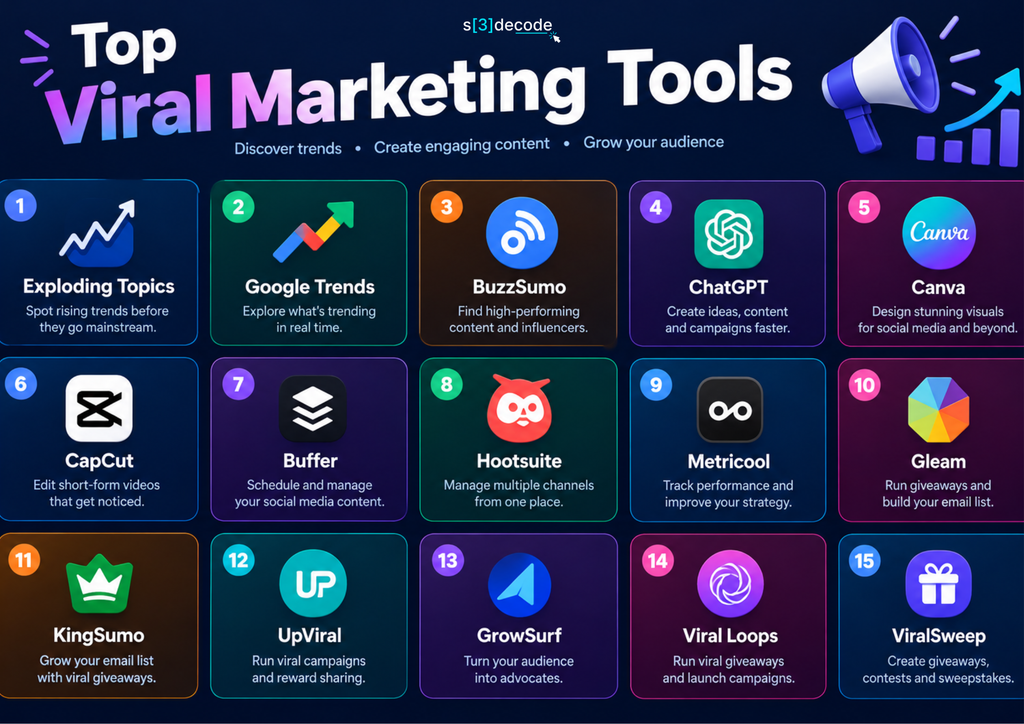
Now that you know what to look for, it’s time to compare the tools themselves. The list below covers different parts of viral marketing from trend discovery and content creation to giveaways, referral programs, affiliate campaigns, social listening, and influencer marketing.
Rather than ranking every platform purely by popularity, we’ve grouped tools around the type of growth they can help create. This makes it easier to find a platform that matches your particular campaign instead of choosing a tool simply because it has “viral” in its name.
For each tool, you’ll find its best use case, starting price, key feature, standout capabilities, and the main pros and cons to consider before signing up.
1. Exploding Topics
Best for: Finding emerging trends before they become mainstream
Starting price: $39/month for the Entrepreneur plan, with a 7-day free trial
Key feature: Early trend discovery and trend tracking
Ideal for: Marketers, founders, content teams, and brands looking for topics with growing audience interest
What It Does
Exploding Topics helps you discover emerging trends, products, markets, and topics that are gaining momentum. Its database currently contains more than 1.1 million trends, with tools for analyzing growth, tracking trends, and exploring broader market patterns.
Instead of focusing only on what’s already popular, the platform is designed to help marketers identify trends before they become mainstream. It analyzes signals from across the internet and uses machine learning to identify patterns that could indicate growing interest.
Why It Can Help With Viral Marketing
Timing can make a major difference in viral marketing. Creating content around a topic after everyone is already talking about it means you’re competing with a much larger amount of content.
Exploding Topics can help you identify emerging subjects early, giving you an opportunity to create content, campaigns, products, or social posts while interest is still growing.
For marketers, this can be particularly useful for finding early content opportunities rather than simply reacting to existing viral trends.
Standout Features
- Trend discovery: Find emerging topics, markets, products, and startups.
- Trend tracking: Monitor selected trends and watch how their interest changes over time.
- Meta Trends: Explore larger market movements and the smaller trends developing within them.
- Trending Products: Research products showing sustained growth and view supporting market data.
Pros & Cons
Pros
- Useful for discovering trends before they become mainstream
- Large database covering multiple industries
- Includes trend analysis and tracking
- Helpful for content and campaign planning
Cons
- The Pro plans can be expensive for individual creators
- Trend discovery doesn’t guarantee that a campaign will go viral
- Some advanced features are available only on higher-tier plans
2. Google Trends
Best for: Identifying trending topics and rising search interest
Starting price: Free
Key feature: Real-time and historical search trend data
Ideal for: Marketers, content creators, SEO teams, and brands looking for timely content opportunities
What It Does
Google Trends shows what people are searching for and how search interest changes over time. You can compare topics, explore rising searches, and examine trends by country, region, or time period. Google’s Trending Now feature also surfaces searches experiencing recent spikes in interest and refreshes its data frequently.
For viral marketing, this makes Google Trends useful for spotting conversations that are gaining momentum before deciding what content or campaign to create.
Why It Can Help With Viral Marketing
Timing is one of the biggest factors in getting content noticed. If a topic is suddenly gaining search interest, creating relevant content while that interest is rising can give you a better opportunity to join the conversation.
For example, marketers can use Google Trends to identify a growing topic, then turn it into a social post, video, blog article, email campaign, or promotional idea.
The tool is particularly useful because you can also compare different topics and see whether interest is actually growing rather than relying on assumptions about what’s popular.
Standout Features
- Trending Now: Find searches that are currently experiencing a spike in interest.
- Trend comparisons: Compare multiple topics or search terms to identify stronger opportunities.
- Geographic insights: See how interest differs across countries and regions.
- Historical data: Examine how interest in a topic has changed over time.
Pros & Cons
Pros
- Completely free to use
- Excellent for spotting emerging topics
- Provides current and historical trend data
- Useful for content, SEO, and social media planning
Cons
- Doesn’t create or distribute marketing content
- Search popularity doesn’t guarantee social virality
- Some trends can be extremely short-lived
3. BuzzSumo
Best for: Discovering viral content, trending topics, and content ideas
Starting price: $199/month
Key feature: Content discovery and trend analysis
Ideal for: Content marketers, agencies, publishers, and brands
What It Does
BuzzSumo helps marketers discover high-performing content, trending topics, and popular stories across different industries. It can also be used to research competitors and identify content that is generating significant engagement.
Why It Can Help With Viral Marketing
BuzzSumo helps you understand what people are already sharing instead of guessing what might perform well. You can find popular topics, examine successful content, and identify emerging conversations that could inspire your next campaign.
Standout Features
- Content performance research
- Trending content discovery
- Competitor analysis
- Topic and question research
Pros & Cons
Pros
- Strong content research capabilities
- Useful for identifying trending topics
- Helpful for competitor research
- Suitable for agencies and marketing teams
Cons
- Relatively expensive for smaller businesses
- Some features may be unnecessary for basic research
- Popular content doesn’t guarantee your content will go viral
4. ChatGPT
Best for: Generating viral content ideas, hooks, social posts, and campaign concepts
Starting price: Free plan available; paid plans vary by plan and region
Key feature: AI-powered content ideation and creation
Ideal for: Marketers, creators, startups, and social media teams
What It Does
ChatGPT can help marketers turn a basic campaign idea into multiple pieces of content. You can use it to brainstorm campaign concepts, write social posts, create video hooks, develop headlines, repurpose existing content, and adapt messaging for different audiences and platforms.
It can also help analyze why a particular piece of content may have performed well and generate new ideas based on the same underlying concept.
Why It Can Help With Viral Marketing
Coming up with a strong idea is often harder than creating the final post. ChatGPT can help marketers explore dozens of angles quickly instead of relying on a single idea.
For example, you could take one product announcement and turn it into different LinkedIn hooks, short-form video concepts, X posts, email ideas, or storytelling angles. This makes it easier to test different approaches and find the messaging that resonates with your audience.
Standout Features
- Content ideation: Generate campaign and content ideas around a topic or product.
- Hook creation: Develop attention-grabbing openings for videos, posts, and articles.
- Content repurposing: Turn one piece of content into multiple formats.
- Campaign brainstorming: Explore creative concepts, messaging angles, and audience-specific ideas.
Pros & Cons
Pros
- Excellent for brainstorming and content ideation
- Can generate multiple creative angles quickly
- Useful across different marketing channels
- Free option available
Cons
- Generated content still needs human editing
- Doesn’t guarantee engagement or virality
- Strong results depend on the quality of your prompts and context
5. Canva
Best for: Creating social media graphics and visual marketing content
Starting price: Free plan available; Canva Pro starts at $15/month for individuals
Key feature: Fast creation of branded visual content
Ideal for: Small businesses, marketers, creators, and social media teams
What It Does
Canva is a visual content creation platform that lets marketers create social media posts, videos, presentations, advertisements, thumbnails, infographics, and other promotional assets without needing advanced design skills.
For viral marketing, it can help turn an idea or campaign into content that is easier to share across platforms such as Instagram, TikTok, LinkedIn, Pinterest, and Facebook.
Why It Can Help With Viral Marketing
Visual content can have a major impact on whether someone stops scrolling or keeps moving. Canva makes it easier to quickly test different designs, headlines, formats, and creative concepts instead of spending hours producing every variation.
For example, a brand running a giveaway could create multiple social graphics for the same campaign, while a content creator could turn one trending topic into several visual posts designed for different platforms.
Standout Features
- Social media templates: Create posts, stories, banners, and other platform-specific content.
- AI-powered tools: Generate and edit visual content using Canva’s AI features.
- Video creation: Produce short promotional videos and social clips.
- Brand tools: Keep fonts, logos, colors, and other brand assets consistent across campaigns.
Pros & Cons
Pros
- Easy for beginners to use
- Large library of templates and design assets
- Useful for both static and video content
- Free plan available
Cons
- Many premium features require Canva Pro
- Popular templates can make content look less distinctive
- Creating attractive visuals doesn’t guarantee engagement or virality
6. CapCut
Best for: Creating short-form videos for social media
Starting price: Free plan available; paid plans vary by region and subscription
Key feature: AI-assisted video editing and short-form content creation
Ideal for: Creators, social media marketers, small businesses, and brands focused on TikTok, Instagram Reels, and YouTube Shorts
What It Does
CapCut is a video editing platform designed for creating and editing short-form content. It includes tools for trimming clips, adding captions, effects, transitions, music, templates, and AI-assisted editing features.
For marketers, it provides a relatively quick way to turn raw footage, product clips, or existing content into social-ready videos.
Why It Can Help With Viral Marketing
Short-form video moves quickly, and marketers often need to test multiple hooks, formats, and creative styles. CapCut makes it easier to produce different versions of the same idea without building every video from scratch.
Its templates, captions, effects, and editing tools can also help businesses adapt content to the fast-moving formats commonly used on short-form video platforms.
Standout Features
- Short-form video editing: Create videos for TikTok, Reels, and Shorts.
- Auto captions: Add subtitles to make videos easier to follow.
- AI tools: Speed up tasks such as editing, background removal, and content creation.
- Templates: Start with pre-built formats and adapt them to your campaign.
Pros & Cons
Pros
- Beginner-friendly video editor
- Strong selection of short-form content tools
- Useful AI-assisted editing features
- Free version available
Cons
- Some advanced features require a paid plan
- Template-based content can feel repetitive
- Video editing alone doesn’t guarantee viral reach
7. Buffer
Best for: Scheduling and distributing social media content
Starting price: Free plan available; paid plans start at $6/month per channel when billed annually
Key feature: Social media scheduling and content publishing
Ideal for: Small businesses, creators, and marketing teams managing content across multiple social platforms
What It Does
Buffer is a social media management platform that helps you plan, schedule, publish, and analyze content across social networks. Instead of manually posting every piece of content, marketers can prepare posts in advance and manage them from one dashboard.
For viral marketing, this can be useful when you’re testing different posts, publishing around trending topics, or maintaining a consistent posting schedule across multiple channels.
Why It Can Help With Viral Marketing
Viral content often depends on timing. A strong post published at the wrong time can easily miss the audience it was created for.
Buffer helps marketers organize their content calendar and schedule posts ahead of time, making it easier to maintain a consistent presence while testing different formats, topics, and publishing times.
Its analytics can also help you identify which posts are generating stronger engagement so you can create more content around what your audience responds to.
Standout Features
- Social scheduling: Plan and publish content across supported social platforms.
- Content calendar: Organize upcoming posts and campaigns in one place.
- Analytics: Track engagement and identify better-performing content.
- AI Assistant: Generate and repurpose social media content within the workflow.
Pros & Cons
Pros
- Simple and beginner-friendly interface
- Useful for planning campaigns in advance
- Supports multiple social platforms
- Free plan available
Cons
- Advanced features require a paid plan
- Analytics depth varies by plan and platform
- Scheduling content alone won’t make it viral
8. Hootsuite
Best for: Managing, scheduling, and monitoring social media campaigns
Starting price: Plans start at $99/month when billed annually
Key feature: Centralized social media management and analytics
Ideal for: Marketing teams, agencies, and businesses managing multiple social media accounts
What It Does
Hootsuite is a social media management platform that lets marketers create, schedule, publish, monitor, and analyze content across multiple social networks from one dashboard.
For viral marketing, it can help teams manage campaigns across several channels without having to switch between individual platforms. It also provides monitoring and analytics that can help marketers understand which content and conversations are gaining traction.
Why It Can Help With Viral Marketing
Viral campaigns rarely stay on one platform. A post that performs well on one network may need to be adapted and distributed elsewhere while the conversation is still active.
Hootsuite makes it easier to coordinate that distribution, monitor audience reactions, and identify content that is generating stronger engagement. This can help marketing teams respond faster when a campaign starts gaining momentum.
Standout Features
- Social scheduling: Plan and publish content across multiple social networks.
- Social listening: Monitor conversations, mentions, and relevant trends.
- Analytics: Measure engagement and campaign performance.
- Team collaboration: Manage social campaigns with multiple users and workflows.
Pros & Cons
Pros
- Strong multi-platform management
- Useful monitoring and analytics capabilities
- Good fit for agencies and larger marketing teams
- Helps centralize social workflows
Cons
- More expensive than simpler scheduling tools
- May be excessive for solo creators or small accounts
- Some advanced capabilities require higher-tier plans
9. Metricool
Best for: Social media scheduling, analytics, and content performance tracking
Starting price: Free plan available; paid plans start at around $20/month depending on billing and plan
Key feature: Combining social media publishing with performance analytics
Ideal for: Creators, small businesses, agencies, and marketing teams managing multiple social channels
What It Does
Metricool combines social media scheduling, analytics, reporting, and content planning in one platform. Marketers can use it to plan posts, manage multiple social profiles, monitor performance, and understand which content is generating the most engagement.
For viral marketing, this gives you a way to move beyond simply publishing content and actually evaluate what is working across your social channels.
Why It Can Help With Viral Marketing
A campaign may start with one successful post, but the real opportunity is understanding why it worked and how to repeat that success.
Metricool helps you compare content performance and identify patterns in engagement, reach, and audience response. You can use those insights to adjust your publishing strategy, experiment with different formats, and focus more of your effort on content that is gaining traction.
Standout Features
- Social media scheduling: Plan and publish content across supported platforms.
- Analytics: Monitor reach, engagement, and content performance.
- Content planning: Organize upcoming posts and campaigns with a visual planner.
- Reporting: Create social media performance reports for your team or clients.
Pros & Cons
Pros
- Combines publishing and analytics in one platform
- Useful for tracking content performance
- Supports multiple social networks
- Free plan available
Cons
- Advanced features require paid plans
- Some features and limits vary by plan
- Analytics can tell you what performed well but not guarantee future virality
10. Gleam
Best for: Giveaways, competitions, rewards, and lead generation
Starting price: Free plan available; paid plans start at $10/month
Key feature: Campaigns with multiple entry and engagement actions
Ideal for: Brands, creators, ecommerce businesses, and marketers running social campaigns
What It Does
Gleam is a marketing platform built around giveaways, competitions, rewards, and other engagement campaigns. It lets businesses create campaigns where participants can complete different actions, such as joining an email list, following a social account, visiting a page, or referring others.
This makes it useful for campaigns where the goal isn’t simply to publish content, but to give people a reason to participate and share it.
Why It Can Help With Viral Marketing
Gleam can help turn a giveaway or competition into a wider acquisition campaign. Instead of relying only on your existing audience, you can encourage participants to complete sharing or referral actions that expose the campaign to their own networks.
For example, an ecommerce brand could run a product giveaway where participants earn additional entries by sharing the campaign or completing other promotional actions. That creates more opportunities for the campaign to reach people who aren’t already familiar with the brand.
Standout Features
- Giveaways and competitions: Create campaigns designed to drive participation.
- Multiple entry actions: Reward participants for completing different marketing actions.
- Social integrations: Connect campaigns with social platforms and other marketing channels.
- Rewards: Use incentives to encourage participation and engagement.
Pros & Cons
Pros
- Easy to create giveaway and competition campaigns
- Multiple ways to encourage participation
- Useful for lead generation
- Supports social and referral-based campaigns
Cons
- Advanced functionality requires paid plans
- Giveaway campaigns can attract users primarily interested in prizes
- May be more feature-rich than necessary for a simple contest
11. KingSumo
Best for: Referral-based giveaways and audience growth
Starting price: Free plan available; paid plans start at $49/month
Key feature: Viral giveaways with built-in referral incentives
Ideal for: Bloggers, creators, startups, ecommerce brands, and businesses looking to grow their audience through giveaways
What It Does
KingSumo is a giveaway platform designed to help businesses create and manage referral-driven giveaways. You can set up a giveaway, collect participant information, and encourage entrants to share the campaign with other people for additional chances to win.
The idea is simple: instead of a giveaway reaching only your existing audience, participants can help distribute it through their own networks.
Why It Can Help With Viral Marketing
Giveaways already provide a reason for people to participate, but referral incentives can give them another reason to share.
For example, someone could enter your giveaway and receive additional entries for referring friends. Those new participants can then refer their own friends, creating a simple chain of audience growth.
This makes KingSumo particularly useful when your goal is to combine giveaway participation, lead generation, and referral-based growth in one campaign.
Standout Features
- Referral giveaways: Encourage participants to bring in additional entrants.
- Social sharing: Give participants simple ways to spread the campaign.
- Lead collection: Collect participant information while running the promotion.
- Giveaway management: Manage entries and select winners from one campaign.
Pros & Cons
Pros
- Simple concept that’s easy for audiences to understand
- Referral mechanics can increase giveaway reach
- Useful for growing email lists
- Suitable for businesses and creators
Cons
- Best suited to giveaway-based campaigns
- Referral incentives can attract people primarily interested in prizes
- Advanced needs may require a higher-priced plan
12. UpViral
Best for: Referral campaigns, giveaways, and viral lead generation
Starting price: Plans start at $99/month
Key feature: Referral-based campaigns that reward participants for bringing in new leads
Ideal for: Marketers, startups, coaches, creators, and businesses running lead-generation campaigns
What It Does
UpViral is a referral marketing platform designed to help businesses create campaigns where participants can earn rewards for sharing, referring friends, or completing specific actions.
Instead of treating a campaign as a one-time promotion, UpViral focuses on creating a system where participants can help bring additional people into the campaign.
Why It Can Help With Viral Marketing
The platform is particularly useful when you want your audience to actively promote your campaign for you.
For example, you could offer a reward for signing up and then give participants additional chances to win when they refer friends. As more people join through those referrals, the campaign can continue expanding beyond your original audience.
This makes UpViral a good option for businesses that want to combine lead generation with referral-driven growth.
Standout Features
- Referral campaigns: Encourage participants to invite friends and contacts.
- Reward systems: Offer incentives for referrals and campaign actions.
- Leaderboards: Add competition to encourage participants to generate more referrals.
- Campaign tracking: Monitor participation and referral performance.
Pros & Cons
Pros
- Built specifically around viral referral campaigns
- Useful for lead generation
- Supports rewards and referral incentives
- Can help extend campaigns beyond an existing audience
Cons
- More expensive than basic giveaway tools
- May be unnecessary for simple social contests
- Campaign results depend heavily on the strength of the incentive and offer
13. GrowSurf
Best for: Referral programs and automated customer acquisition
Starting price: Plans start at $99/month
Key feature: No-code referral program creation and automation
Ideal for: SaaS companies, startups, and online businesses that want to turn existing customers into referral sources
What It Does
GrowSurf helps businesses create and manage customer referral programs without building the entire system from scratch. You can set up referral campaigns, track who referred new users, and automate parts of the reward and communication process.
The platform is particularly suited to businesses where one customer can naturally introduce another customer, such as SaaS products, subscription services, and online platforms.
Why It Can Help With Viral Marketing
GrowSurf focuses on one of the most repeatable forms of viral growth: customer referrals.
Instead of asking customers to simply share a social post, you can give them a direct incentive to introduce people they know to your product. When new users join through those referrals, they can potentially become referrers themselves, creating a continuous acquisition loop.
This makes GrowSurf more useful for businesses looking for long-term referral growth rather than a short-lived giveaway campaign.
Standout Features
- Referral program builder: Create referral campaigns without developing the system from scratch.
- Automated referrals: Track referral activity and automate campaign workflows.
- Reward management: Set up incentives for successful referrals.
- Integrations: Connect referral campaigns with your existing marketing and business tools.
Pros & Cons
Pros
- Designed specifically for referral marketing
- Useful for SaaS and subscription businesses
- Reduces the technical work involved in building a referral program
- Supports automated referral workflows
Cons
- More expensive than basic giveaway platforms
- Primarily focused on referral-driven growth
- May be unnecessary for businesses without a natural referral opportunity
14. Viral Loops
Best for: Building referral campaigns and viral growth loops
Starting price: Plans start at $49/month
Key feature: Pre-built viral campaign templates for different growth strategies
Ideal for: Startups, SaaS companies, marketers, and growth teams that want to experiment with referral-driven acquisition
What It Does
Viral Loops is a referral marketing platform that helps businesses create campaigns designed to encourage users to invite other people. Rather than building a referral system from scratch, marketers can use campaign templates and customize them around their own product, audience, and rewards.
The platform is particularly useful for businesses that want to experiment with different types of referral campaigns without developing all of the underlying technology themselves.
Why It Can Help With Viral Marketing
Viral Loops is built around the idea that your existing users can become a source of new customer acquisition. A campaign can reward people for inviting friends, sharing a product, or reaching specific referral milestones.
This can create a viral loop, where existing users bring in new users and those new users have an opportunity to continue the cycle.
For a startup launching a new product, for example, a referral campaign can be used to encourage early users to invite their network in exchange for credits, discounts, early access, or other rewards.
Standout Features
- Campaign templates: Start with pre-built referral campaign structures.
- Referral tracking: Monitor invitations and referral activity.
- Reward management: Create incentives around successful referrals.
- Integrations: Connect campaigns with other marketing and business tools.
Pros & Cons
Pros
- Built specifically for referral and viral campaigns
- Campaign templates can reduce setup time
- Useful for testing different referral strategies
- Suitable for startups and SaaS businesses
Cons
- Primarily focused on referral-driven campaigns
- Some advanced requirements may need technical setup
- Referral campaigns still need a compelling incentive to perform well
15. ViralSweep
Best for: Giveaways, contests, sweepstakes, and lead generation
Starting price: Plans start at $49/month
Key feature: Customizable giveaways and promotional campaigns with multiple entry methods
Ideal for: Ecommerce brands, agencies, creators, and businesses that want to use contests to increase engagement and grow their audience
What It Does
ViralSweep is a promotion and giveaway platform that helps businesses create sweepstakes, contests, giveaways, and other campaigns. Marketers can customize how people enter, collect leads, and encourage participants to complete additional actions.
It is designed to make promotional campaigns easier to launch while giving businesses more control over how participants interact with the campaign.
Why It Can Help With Viral Marketing
A giveaway can generate attention, but its reach can be limited if people have no reason to share it. ViralSweep allows marketers to build additional actions and sharing opportunities into their campaigns.
For example, a brand could give participants additional entries for sharing a promotion, referring friends, or completing other campaign actions. This can help the original promotion reach audiences beyond the brand’s existing followers.
Standout Features
- Giveaways and sweepstakes: Create different types of promotional campaigns.
- Multiple entry methods: Give participants different ways to engage with a campaign.
- Lead generation: Collect useful customer information during promotions.
- Campaign customization: Adapt campaigns to match your brand and marketing goals.
Pros & Cons
Pros
- Strong focus on giveaways and promotional campaigns
- Multiple ways to encourage participation
- Useful for lead generation
- Suitable for ecommerce and marketing campaigns
Cons
- Best suited to promotion-based marketing
- Paid plans may be expensive for occasional campaigns
- A giveaway can generate participants without necessarily generating long-term customers
Viral Marketing vs Viral Growth
The terms viral marketing and viral growth are often used interchangeably, but they aren’t exactly the same. It usually focuses on getting content or campaigns shared, while viral growth focuses on creating a system where users help bring in more users.
Viral Marketing
Viral marketing is generally campaign-focused. The goal is to create something people want to share with their friends, followers, or communities. Examples include:
- A social media campaign
- A giveaway
- A viral video
- A contest
- An influencer campaign
- A shareable piece of content
Tools such as Canva, CapCut, BuzzSumo, Gleam, and ViralSweep can support different parts of this process. The campaign may generate a huge amount of attention, but that attention doesn’t necessarily continue after the campaign ends.
Viral Growth
Viral growth is more focused on creating a repeatable acquisition loop. For example, a SaaS company might give an existing customer additional credits for every new user they refer. Those new users can then receive the same referral opportunity, allowing the acquisition cycle to continue.
Tools such as GrowSurf, Viral Loops and UpViral are better suited to this type of strategy.
Which One Should You Use?
It depends on your objective.
If you want to generate a sudden increase in attention, a giveaway, social campaign, influencer promotion, or highly shareable piece of content may be the better approach.
If you want to turn customers into a recurring acquisition channel, a referral or viral-loop platform may make more sense.
You can also combine both. For example, a company could use a giveaway to attract its first audience and then introduce a referral program to keep that audience generating new customers over time.
The important distinction is simple: viral marketing helps people spread your campaign, while viral growth builds sharing into the way your business acquires users.
How to Create a Viral Marketing Campaign
A viral campaign needs more than a giveaway, referral link, or social post. The campaign has to give people a clear reason to participate and an easy way to share it. The best approach is to build the campaign around one specific goal and then choose the tools that support it.
Start With One Clear Goal
Decide what you want the campaign to generate before choosing a platform. It could be:
- More product signups
- Email subscribers
- App installs
- Social followers
- Website traffic
- Customer referrals
- Product sales
Trying to achieve everything with one campaign usually makes the message less clear.
Create a Strong Reason to Participate
People are unlikely to share a campaign simply because a brand asks them to. Give them something worth acting on. Depending on your business, that could be:
- A discount
- Free product or credits
- Early access
- Exclusive content
- A prize
- Loyalty rewards
- Referral bonuses
The incentive should also make sense for your target audience. A large giveaway may generate plenty of entries but very few potential customers if the prize has nothing to do with your product.
Make Sharing Part of the Experience
The sharing process should require as little effort as possible. For a referral campaign, this might mean giving each participant a unique referral link. For a giveaway, you could provide additional entries when someone refers friends or shares the campaign.
This is where platforms such as Gleam, KingSumo, UpViral, GrowSurf, Viral Loops, and ViralSweep can be useful because they can handle parts of the participation and referral process.
Promote the Campaign in Multiple Places
Don’t depend on one channel. Your campaign could be promoted through:
- Social media
- Influencers
- Your website
- Existing customers
- Affiliate partners
- Online communities
The goal is to create several entry points into the same campaign while keeping the core message consistent.
Track What Actually Works
A campaign can generate thousands of clicks and still fail to produce meaningful business results. Track metrics that connect attention to your actual goal, such as referral rate, conversion rate, new customers, revenue, cost per acquisition, and customer lifetime value.
Once you know which channel, incentive, or campaign element is producing the strongest results, you can improve the next campaign instead of simply trying to recreate the previous one.
Ultimately, the strongest viral campaigns have three things in common: a compelling reason to participate, a simple way to share, and a clear business objective behind the campaign.
Conclusion
Going viral is rarely the result of one perfect post or one marketing platform. It usually happens when good content, the right audience, and a reason to share come together.
That’s why the best viral marketing tool depends on what you’re trying to achieve. Use trend and content tools when you need to discover opportunities and create attention-grabbing campaigns. Choose referral, giveaway, or viral-loop platforms when you want your audience to actively bring more people into your campaign.
You don’t need a complicated marketing stack to get started. Pick the growth mechanism that fits your business, choose one tool that supports it, and test a campaign with a clear goal.
If people genuinely find your product, offer, or content worth sharing, the right tool can help turn that interest into measurable growth.