![s[3]decode](https://s3decode.com/wp-content/uploads/2026/05/logo-s3decode.png)
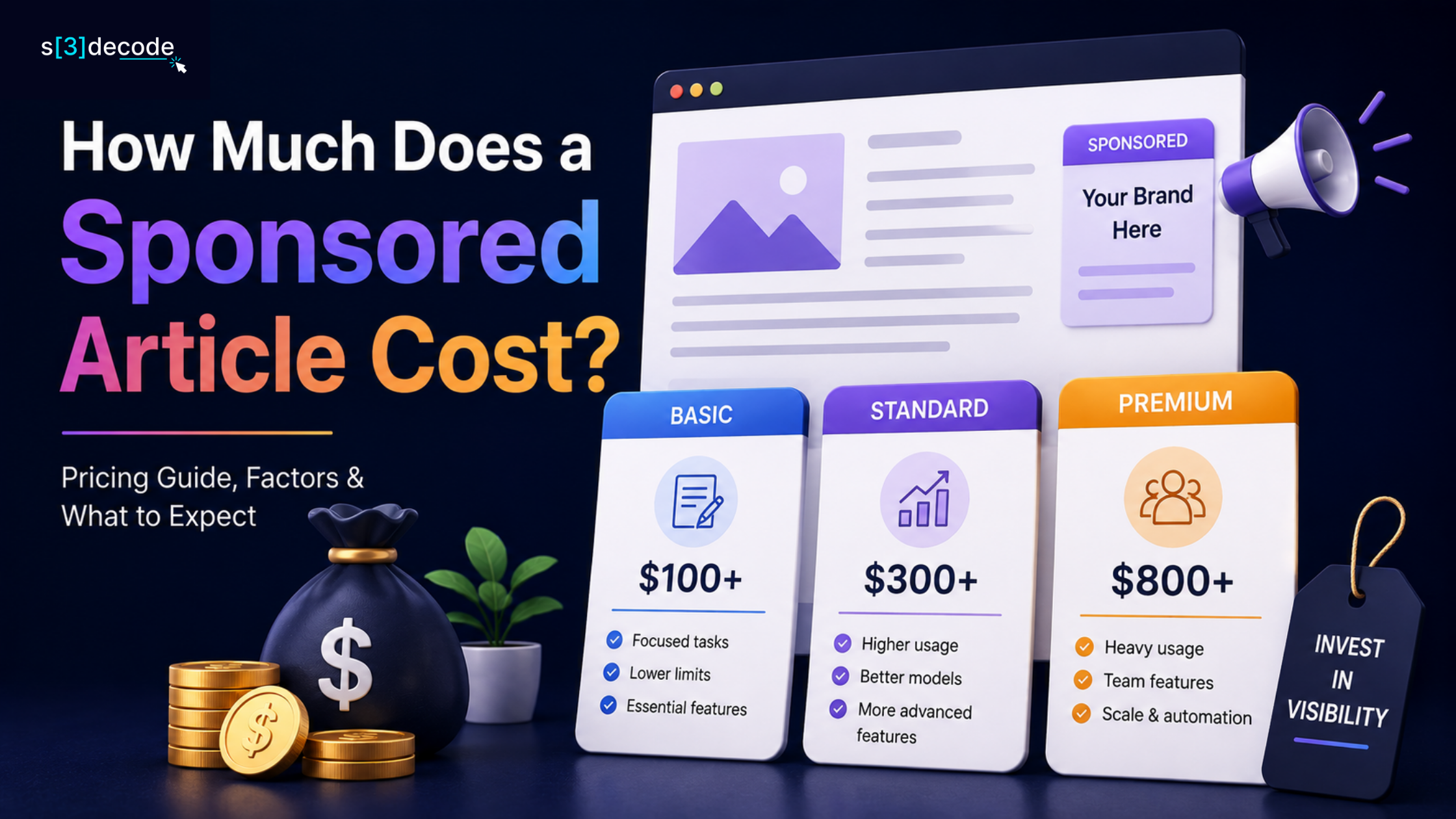
A sponsored article can cost anywhere from under $100 to several thousand dollars in 2026. There isn’t one standard rate because publishers price sponsored content based on factors such as website traffic, audience quality, niche, authority, editorial standards, content requirements, and whether the placement includes additional promotion.
Recent 2026 guest-post pricing research shows just how wide the market is. One analysis of more than 52,000 websites found an average direct guest-post price of about $459, while another analysis of 22,000 placements reported an average of $164. The difference highlights an important point: averages can be useful for context, but they don’t tell you what a specific website should charge.
So, if you’re wondering “How much should I pay for a sponsored article?” or “How much should I charge for a sponsored post?”, the better question is what you’re actually getting for the price.
In this guide, we’ll break down sponsored article costs in 2026, typical pricing ranges, the factors that influence rates, what publishers usually include, and how advertisers can evaluate whether a sponsored-content deal is worth the money.
Sponsored Article Cost in 2026: Quick Overview
As a general market reference, you can expect sponsored article pricing to look something like this:
| Website Type | Typical Sponsored Article Cost |
|---|---|
| Small or newer website | $50–$150 |
| Established niche website | $150–$400 |
| Strong authority website | $400–$1,000 |
| High-traffic publication | $1,000–$2,500+ |
| Major media/publication | $2,500–$10,000+ |
These are practical market ranges rather than fixed industry rates. Individual websites can charge considerably more or less depending on their audience and commercial demand.
For comparison, BuzzStream’s 2026 analysis found that the average cost of buying a guest post directly from a site was $295, while vendors charged an average of $461.
That difference is important because buying directly from a publisher isn’t the same as purchasing a managed guest-post or link-building service. A middleman may be charging for prospecting, outreach, content creation, negotiation, quality control, and campaign management.
What Is a Sponsored Article?
A sponsored article is content published on a website because a company or individual has paid the publisher for the placement. Depending on the agreement, the advertiser may provide the article themselves, ask the publisher to write it, or work with the publisher on an editorial brief.
For example, a SaaS company might pay a technology publication to publish an article about a particular software category. The article could introduce the company, discuss a relevant problem, and include the brand as part of the content.
Sponsored articles can serve several purposes:
- Brand awareness
- Referral traffic
- Audience exposure
- Thought leadership
- Product promotion
- Content distribution
- PR and reputation building
However, sponsored content and paid SEO links aren’t necessarily the same thing. If the primary objective is to obtain a link that passes ranking signals, Google has specific guidance around paid links. Google recommends using rel="sponsored" for advertisements or paid placements and also accepts nofollow for qualifying paid links.
That distinction matters when comparing sponsored-content offers.
What Determines the Cost of a Sponsored Article?
Two websites can have similar-looking SEO metrics and charge completely different prices. Why? Because website value isn’t determined by a single metric.
1. Website Traffic
Traffic is one of the biggest factors affecting sponsored article pricing. A website receiving thousands of relevant visitors every month can potentially provide much more exposure than a site with very little real readership.
For advertisers, however, relevant traffic is more valuable than inflated traffic.
A technology company would generally get more value from 20,000 monthly visitors interested in software than from 100,000 visitors with no connection to its product.
That’s why you shouldn’t evaluate a sponsored article purely by monthly traffic. Look at where the visitors come from, what they read, and whether the audience matches your target market.
2. Website Authority
Publishers with established authority can command higher rates because they’ve spent years building their reputation, content library, backlinks, and audience.
Metrics such as:
- Domain Rating (DR)
- Domain Authority (DA)
- Domain age
- Referring domains
- Organic visibility
can help evaluate a site. But these numbers shouldn’t be treated as the final answer.
A website can have impressive SEO metrics and still have very little genuine readership. In fact, guest-post research warns advertisers to look beyond authority metrics and consider whether a website has a real, engaged audience.
3. Niche
Some industries command higher sponsored-content rates than others. Technology, SaaS, finance, cybersecurity, marketing, business, and other commercially valuable niches can attract strong advertiser demand.
A highly specialized website can also charge more because its audience is particularly valuable. For example, an article published on a cybersecurity website may be much more valuable to a security software company than a general lifestyle website with substantially higher traffic.
Audience relevance can outweigh raw traffic.
4. Editorial Quality
A sponsored article on a heavily moderated publication is different from uploading an article to a site that accepts almost anything. Publishers that:
- Review submissions
- Edit content
- Fact-check claims
- Maintain strict topic guidelines
- Reject low-quality promotional content
- Limit the number of sponsored articles
have more editorial value to offer. That additional work can justify a higher price.
5. Content Creation
Some publishers charge only for the placement. Others include writing in the package. For example:
A Option – Placement only:
You provide the finished article and pay for publication.
B Option – Writing + publication:
The publisher or their writer creates the article and publishes it.
C Option – Premium sponsored package:
Writing, editing, publication, homepage placement, newsletter promotion, social promotion, and other distribution may be included.
Naturally, these shouldn’t cost the same. Always ask exactly what is included before comparing two quotes.
Sponsored Article Pricing by Website Size
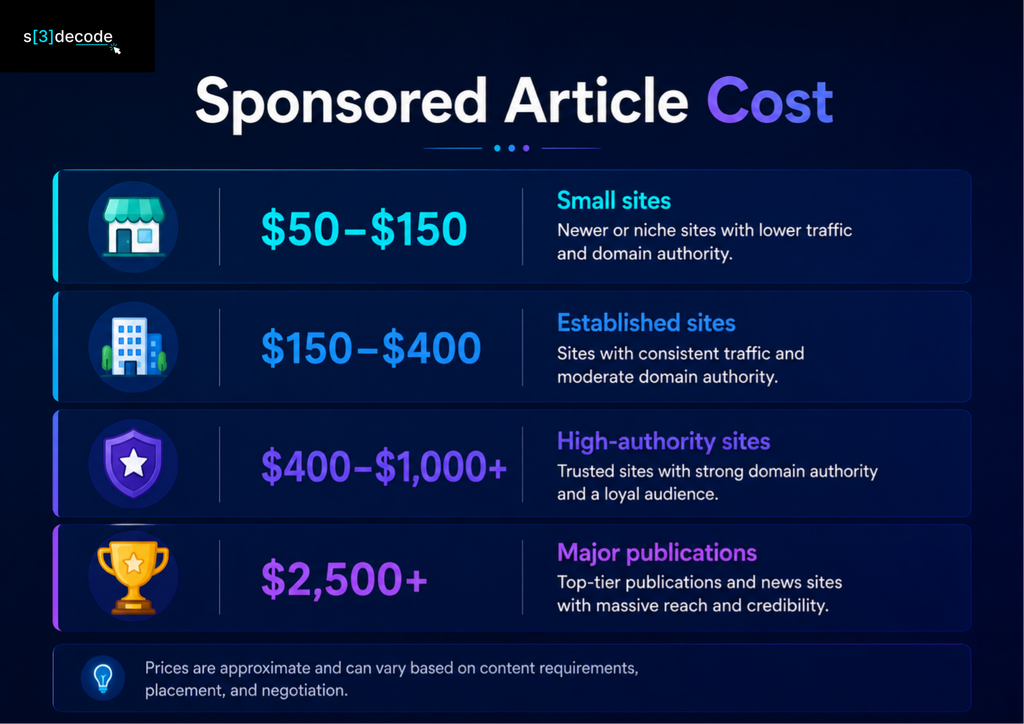
Here’s a more practical way to think about the market.
$50–$150: Small Websites
At this level, you’ll typically find newer websites, smaller niche publications, and sites with modest traffic.
These placements can make sense when you’re primarily looking for:
- Niche relevance
- Brand mentions
- Referral opportunities
- Affordable content distribution
But this is also the range where quality varies dramatically. A cheap sponsored article isn’t necessarily a bargain if the website has no audience, publishes hundreds of unrelated paid posts, or has questionable content quality.
Looking to publish Sponsored Article? Check our Write for Us page for pricing, content guidelines, and submission details.
$150–$400: Established Niche Sites
This is often a more interesting range for small businesses and startups. You can find websites with an established content library, genuine topical relevance, and a meaningful audience without paying premium-media rates.
The exact price depends heavily on the site’s metrics and audience.
Recent industry research places average guest-post pricing in this general territory, although reported averages vary significantly depending on the dataset and methodology.
$400–$1,000: Strong Authority Publications
At this level, you’re generally paying for more than a URL. The website may have:
- Strong organic visibility
- Significant referring-domain strength
- Established brand recognition
- High-quality editorial standards
- A valuable professional audience
- Consistent readership
For companies selling higher-value products or services, a placement at this level can make sense if the audience is genuinely relevant.
$1,000+: Premium Publications
Once you’re above $1,000, you’re entering premium territory. These placements may involve larger publications, significant traffic, recognizable brands, editorial review, prominent placement, or additional promotional exposure.
At this point, advertisers should stop asking only “How strong is the backlink?” Instead, ask:
“How much business value can this audience create?”
A $2,000 placement that puts your company in front of a highly relevant audience can potentially be more valuable than ten $200 placements on unrelated websites.
Red Flags When Buying Sponsored Articles
A low price can sometimes be a warning sign. Be cautious when a publisher:
- Accepts every niche imaginable
- Publishes large numbers of unrelated sponsored articles
- Guarantees ranking improvements
- Sells “dofollow links” as the main benefit
- Has suspicious traffic patterns
- Has little organic visibility despite high SEO metrics
- Provides no information about its audience
- Offers extremely cheap placements on a supposedly authoritative site
The goal shouldn’t be to find the cheapest sponsored article. It should be to find a publication where the price makes sense relative to the audience and exposure you’re buying.
Sponsored Article vs Guest Post: What’s the Difference?
The terms are often used interchangeably, but there can be a practical difference. A guest post usually refers to content contributed to another website, often by an external author or brand.
A sponsored article generally involves a commercial arrangement where the advertiser pays for publication or promotion.
In reality, many websites use the terms differently. That’s why it’s better to ask the publisher directly:
What exactly am I paying for?
You want to know whether you’re purchasing editorial exposure, content creation, advertising space, a brand mention, a link placement, or a combination of these.
Is Paying for a Sponsored Article Worth It in 2026?
It can be, but only when the publication is worth reaching.
The strongest sponsored-content opportunities aren’t necessarily the websites with the highest DA. They’re the websites where your potential customers actually spend time.
Imagine two options:
Website A
- DA 70
- Very little relevant traffic
- Broad collection of unrelated topics
- $300 placement
Website B
- DA 45
- Strong audience in your exact industry
- Consistent organic traffic
- High-quality editorial content
- $350 placement
In this, website B could easily be the better marketing investment. This is why sponsored content should be treated as media buying and content marketing, not simply as link buying.
How to Find Websites for Sponsored Articles
Finding a website willing to publish sponsored content is easy. Finding one that’s actually worth paying for is the harder part.
You can find potential publishers through Google searches, competitor research, SEO tools, industry publications, and publisher marketplaces. But don’t build your list based only on websites advertising “sponsored posts.” A site can accept paid content and still have little audience value.
The goal is to find websites that are relevant, active, credible, and commercially useful.
1. Search Google for Sponsored Content Opportunities
Start with searches related to your industry. For example, if you’re promoting an SEO product, you could search:
"sponsored post" + SEO"sponsored article" + marketing"advertise with us" + technology"contribute" + SaaS"write for us" + digital marketing"guest post guidelines" + softwareinurl:sponsored + technology
Don’t limit yourself to the exact phrase “sponsored article.” Publishers may use terms such as partner content, contributor article, branded content, native advertising, or guest contribution.
Search results can help you discover sites that already have a process for accepting external content. However, treat a “Write for Us” page as a starting point, not proof that the website is high quality. Many contribution pages are outdated or exist primarily to attract link buyers.
2. Look at Where Your Competitors Are Published
Competitor research can be one of the fastest ways to discover relevant publications. Take a few competitors and examine their backlink profiles using tools such as Ahrefs or Semrush. Look for websites that have published:
- Expert contributions
- Industry articles
- Product reviews
- Interviews
- Sponsored content
- Brand mentions
If several competitors in the same industry are being mentioned by a publication, that’s a useful signal that its audience may overlap with yours.
3. Find Websites That Already Cover Your Topic
You don’t necessarily need a website with a “Write for Us“ page. In fact, some valuable publications don’t publicly advertise contributor opportunities. Search for websites that already publish content around your subject.
Look at their recent articles, authors, audience, traffic, and editorial style. If the publication regularly covers topics relevant to your business, it may be worth contacting the editor even if there’s no public submission page.
4. Use SEO Tools to Check the Website
Once you’ve found a potential publisher, don’t immediately ask for the price. First, check whether the website is actually healthy.
Useful metrics include:
| What to Check | Why It Matters |
|---|---|
| Organic traffic | Indicates potential search visibility |
| Traffic trend | Helps identify growth or decline |
| Referring domains | Shows backlink profile |
| DA/DR | Useful as a supporting authority metric |
| Top-ranking pages | Reveals what the site actually ranks for |
| Traffic countries | Important for international campaigns |
| Topical relevance | Shows whether the audience matches your niche |
| Outbound links | Helps identify excessive paid-link activity |
Don’t treat DA or DR as the deciding factor.
A website with a lower authority score but a highly relevant audience can be a better sponsored-content opportunity than a high-DR site with unrelated traffic. Current guest-post research similarly recommends evaluating relevance, organic visibility, editorial quality, and audience fit together rather than relying on a single SEO metric.
5. Check the Website’s Recent Content
This is one step people often skip.
Open the site’s blog and look at the last 20–30 articles.
Ask yourself:
- Are the articles genuinely useful?
- Are topics related to the site’s stated niche?
- Are articles professionally edited?
- Are different authors contributing?
- Does every article contain multiple promotional links?
- Are there dozens of unrelated industries being published?
- Does the website appear to publish mainly for advertisers?
If a technology website suddenly publishes articles about casinos, CBD, loans, plumbing, cryptocurrency, fashion, and pet products every week, that’s a warning sign. A real publication usually has a recognizable editorial focus.
6. Check Whether the Site Has Real Readers
Traffic is important, but traffic quality matters more than the number shown in an SEO tool.
Look at:
- Which countries generate traffic
- Which pages receive visitors
- Whether traffic is increasing or declining
- Search keywords
- Engagement signals where available
- Social presence
- Newsletter or community activity
For example, if you’re selling software to businesses in the United States, a publisher with mostly U.S. business readers may be more valuable than a site with several times the traffic but an unrelated international audience.
7. Contact the Publisher Directly
Once you’ve shortlisted a site, contact the owner, editor, or advertising team.
Keep your first message simple.
Tell them:
- Who you are
- What company or website you represent
- What type of article you’re interested in
- The topic or general category
- That you’re interested in sponsored content
- Whether they have publishing guidelines and rates
Don’t immediately send a generic 1,000-word article. First establish whether the publisher accepts your topic and understand the terms.
8. Ask What the Price Actually Includes
A publisher might quote: “$300 for a sponsored article.”
That doesn’t tell you enough. Before paying, ask:
- Is content creation included?
- How many links are allowed?
- Are links marked
sponsoredornofollow? - Is the article permanently published?
- Is there a minimum word count?
- Are images included?
- Is editing included?
- Will the article appear on the homepage?
- Is newsletter promotion included?
- Is social promotion included?
- How long is the turnaround?
- Can the publisher remove the article later?
These details can dramatically change the value of the offer.
9. Consider Publisher Marketplaces
If you don’t want to manually find and contact hundreds of websites, publisher marketplaces can speed up the process. These platforms can provide searchable inventories where you can filter publishers by factors such as niche, location, traffic, authority, price, and turnaround time.
The advantage is efficiency. The disadvantage is that you still need to vet the individual publication. A marketplace listing doesn’t automatically make a website a good fit.
A Simple Sponsored Article Site Checklist
Before approving a publisher, score it against a few basic criteria:
| Factor | Good Sign |
|---|---|
| Relevance | Same or closely related niche |
| Audience | Matches your target customers |
| Traffic | Genuine and consistent |
| Content | High-quality and useful |
| Editorial standards | Clear review process |
| Backlink profile | Natural and relevant |
| Sponsored content | Clearly disclosed |
| Pricing | Reasonable for the actual exposure |
| Publication history | Active and consistent |
| Promotional value | Real audience beyond the link |
If a site fails several of these checks, a low price shouldn’t convince you to buy.
Don’t Choose a Site Just Because It Sells Sponsored Posts
This is probably the most important part of the process. You’re not looking for a website that will accept your money. You’re looking for a publication whose audience is worth reaching.
That’s an important distinction, particularly for SEO campaigns. Google’s current spam policies state that buying or selling links for ranking purposes can violate its spam policies, while paid advertising links can be used when they are appropriately qualified with attributes such as rel=”sponsored" or rel=”nofollow”. So, evaluate sponsored content as a marketing placement first.
If the article reaches the right audience, builds brand awareness, generates referral traffic, and provides useful exposure, it can have value even when the link itself isn’t passing ranking credit.
Find the audience first. Compare the price second.
Final Thoughts
Sponsored article prices in 2026 vary enormously, from affordable placements on smaller niche websites to several thousand dollars for premium publications.
Current industry studies demonstrate that there isn’t even one universal market average: reported 2026 guest-post averages range from roughly $150 to $450, depending on the dataset, while direct publisher pricing can differ substantially from managed-service pricing.
So don’t choose a sponsored article based on price alone.
Look at traffic, audience relevance, editorial quality, authority, content quality, promotional opportunities, and the actual deliverables included in the package.