![s[3]decode](https://s3decode.com/wp-content/uploads/2026/05/logo-s3decode.png)
At first glance, Java and JavaScript can look like two versions of the same programming language. The names are almost identical, both use familiar programming concepts such as variables, functions, objects, loops, and conditional statements, and both are widely used in professional software development.
But the similarity largely ends there.
Java and JavaScript are separate programming languages with different type systems, execution models, runtimes, ecosystems, and typical use cases. MDN explicitly notes that JavaScript should not be confused with Java and that the two have significantly different syntax, semantics, and uses.
Java is a statically typed, class-based language designed for portability, performance, concurrency, and large-scale application development. JavaScript is a dynamically typed, multi-paradigm language best known for powering browser interactivity, but it also runs on servers and other environments through runtimes such as Node.js.
So, if you’re trying to decide Java vs JavaScript, the better question isn’t “Which language is better?”
It’s:
Which language is better suited to the software you’re trying to build?
Java vs JavaScript: Quick Comparison
| Feature | Java | JavaScript |
|---|---|---|
| Type system | Statically typed | Dynamically typed |
| Programming model | Primarily class-based OOP | Multi-paradigm, prototype-based + classes |
| Primary runtime | JVM | Browser engines, Node.js, Deno, Bun and others |
| Compilation/execution | Compiled to JVM bytecode, then executed/JIT-compiled by JVM | Interpreted/JIT-compiled by JavaScript engines |
| Browser use | Not the standard browser language today | Core browser programming language |
| Server-side development | Very common | Very common |
| Front-end development | Not normally used | One of the primary choices |
| Enterprise applications | Strong | Strong |
| Mobile development | Strong historical/current ecosystem, especially Android-related Java codebases | Usually through frameworks/toolchains |
| Concurrency | Threads, executors, virtual threads and JVM concurrency facilities | Event loop + asynchronous programming; workers for parallel execution |
| Type safety | Strong compile-time checking | More runtime/dynamic behavior |
| Learning curve | Generally steeper | Often easier to start with |
| Typical strengths | Enterprise systems, backend services, large applications | Web apps, browser interfaces, full-stack JavaScript |
| Standard | Java Language Specification | ECMAScript |
What Is Java?
Java is a general-purpose, concurrent, object-oriented programming language built around the Java Virtual Machine (JVM). The JVM is one of the defining parts of the Java platform because it allows Java applications to run across different operating systems and hardware environments.
The basic idea is often summarized as:
Java source code → Java compiler → bytecode → JVM → execution
Instead of compiling Java directly into a platform-specific executable, the compiler produces JVM bytecode. The JVM then executes and optimizes that bytecode for the environment where the application is running.
Modern JVM implementations also use techniques such as Just-In-Time (JIT) compilation to optimize frequently executed code. Oracle’s JVM documentation describes HotSpot’s adaptive compiler as identifying performance-critical sections and compiling them for improved execution speed.
This architecture has helped Java become particularly important in large server-side and enterprise environments.
Oracle currently states that more than 73 billion JVMs are running worldwide, illustrating the enormous scale of the Java ecosystem
What Is JavaScript?
JavaScript began as a language for adding dynamic behavior to web pages, but it has grown into a general-purpose language used across browsers, servers, desktop applications, serverless environments, and other platforms.
In a browser, JavaScript can interact with the Document Object Model (DOM), respond to user actions, make network requests, update page content, manipulate browser APIs, and create interactive experiences.
For example, when you click a button and a menu opens without the page reloading, JavaScript may be responsible for that interaction.
But JavaScript is no longer restricted to the browser.
Server-side runtimes such as Node.js allow developers to use JavaScript for backend applications as well. MDN notes that JavaScript is used in environments including browsers, Node.js, Deno, and Bun.
This has made JavaScript particularly interesting for businesses that want to use one primary language across both frontend and backend development.
Difference Between Java and JavaScript
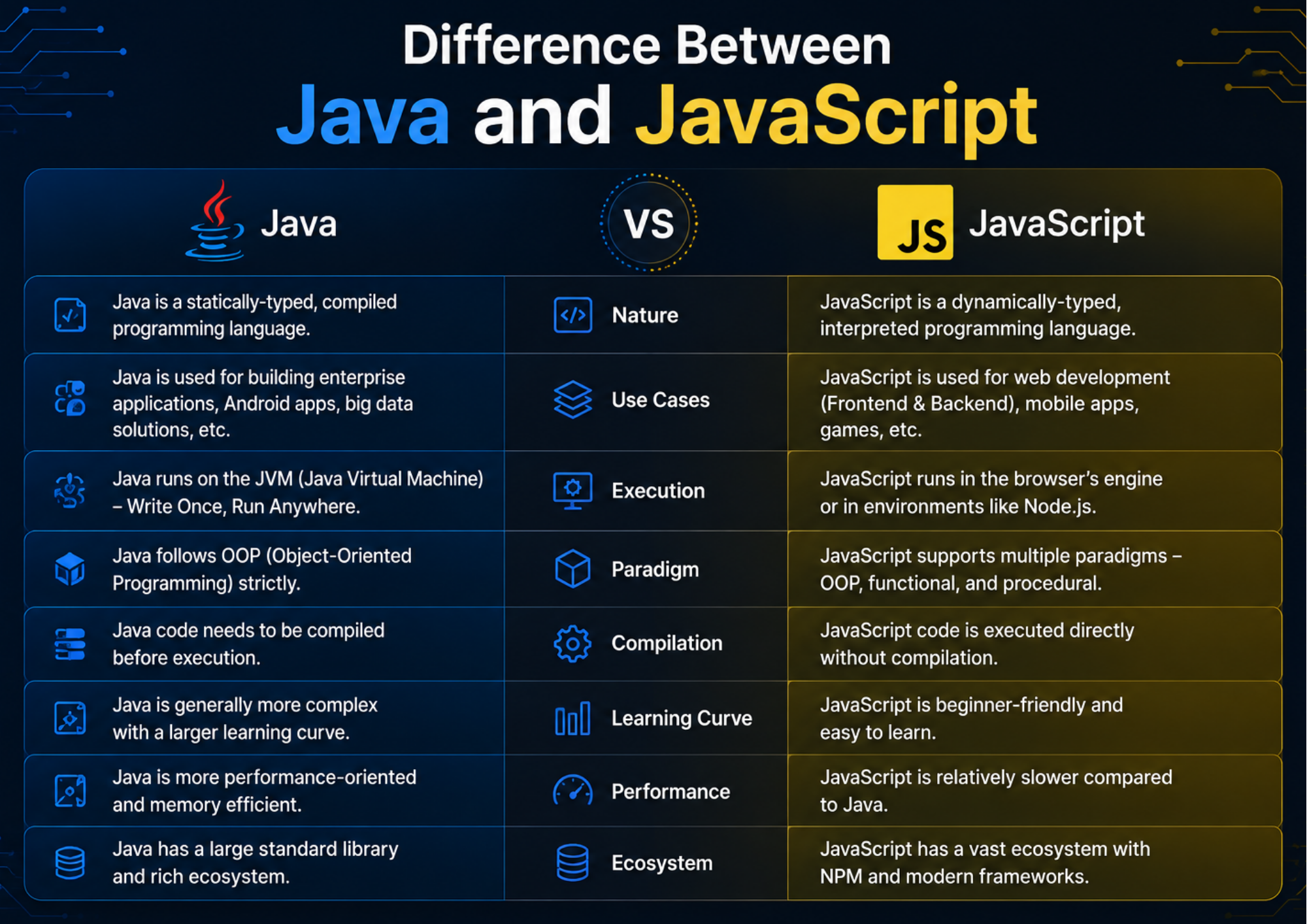
The Biggest Difference: Java vs JavaScript Are Not the Same Language
This is worth emphasizing because the names create so much confusion. JavaScript wasn’t created as a browser version of Java.
The languages share some syntax and naming conventions, partly because JavaScript’s syntax was influenced by languages including Java and C. But their underlying designs are fundamentally different.
A useful analogy is:
Java and JavaScript are like two tools that happen to have similar names—not two versions of the same tool.
Their object models, type systems, runtimes, standard libraries, and typical development environments are different.
Java vs JavaScript: Type Systems
One of the most important technical differences is how the languages handle types.
Java uses static typing
In Java, developers generally declare the type of a variable:
int age = 30;
String name = "Alex";
The compiler can detect many type-related problems before the program runs.
For large applications, this can be extremely useful because developers can catch certain classes of mistakes during development rather than discovering them only after execution. Java’s strong type system also makes large codebases easier to reason about when many developers are working on the same system.
JavaScript uses dynamic typing
JavaScript allows variables to hold values of different types without requiring the developer to declare the variable’s type in the same way:
let age = 30;
let name = "Alex";
The language determines the value’s type at runtime. This makes JavaScript flexible and often quick to prototype with, but it also means developers need to understand runtime type behaviour carefully.
For example:
let value = "10";
let result = value + 5;
The result is 105 rather than 15, because JavaScript’s + operator performs string concatenation in this situation. This flexibility is powerful, but it can also produce unexpected behavior if developers don’t understand JavaScript’s type coercion rules. MDN describes JavaScript as dynamically typed, while Java uses a statically typed model with stronger compile-time checking.
Java vs JavaScript: Object-Oriented Programming
Both languages support object-oriented programming, but their object models are different. Java is fundamentally class-based. Developers define classes and create objects from those classes.
class User {
String name;
}
JavaScript historically used prototype-based inheritance. Modern JavaScript also provides class syntax, but those classes operate on top of JavaScript’s prototype-based object model.
class User {
constructor(name) {
this.name = name;
}
}
This is one reason JavaScript can look surprisingly similar to Java when you first see the syntax.
Underneath, however, the object models remain different. MDN specifically distinguishes Java’s class-based model from JavaScript’s prototype-based model.
Java vs JavaScript: How They Run
The execution model is another major difference.
Java
Java applications typically go through a compilation process:
.java source → bytecode → JVM
The JVM then executes the bytecode and can apply runtime optimizations such as JIT compilation. This approach gives Java a strong combination of portability and runtime performance.
JavaScript
JavaScript is executed by a JavaScript engine.
In a browser, different browsers use different engines. For example, Chrome and Chromium-based environments use V8, while Firefox uses SpiderMonkey.
Modern JavaScript engines don’t simply interpret every instruction literally. They use sophisticated runtime optimization and JIT compilation techniques. So the simplistic statement that “Java is compiled and JavaScript is interpreted” isn’t technically sufficient for modern development.
A better distinction is:
Java is compiled into JVM bytecode and executed by the JVM, while JavaScript is executed by JavaScript engines that can interpret and JIT-compile code at runtime.
MDN describes JavaScript as interpreted/JIT-compiled, while Oracle documents JVM execution and JIT optimization for Java.
Java vs JavaScript for Web Development
This is where the difference becomes particularly obvious.
JavaScript is a fundamental technology for interactive web applications. In a browser, JavaScript can manipulate page content, respond to events, communicate with servers, and interact with browser APIs.
Java, meanwhile, is not the standard language for modern browser-side application logic. Instead, Java is commonly used on the backend.
For example:
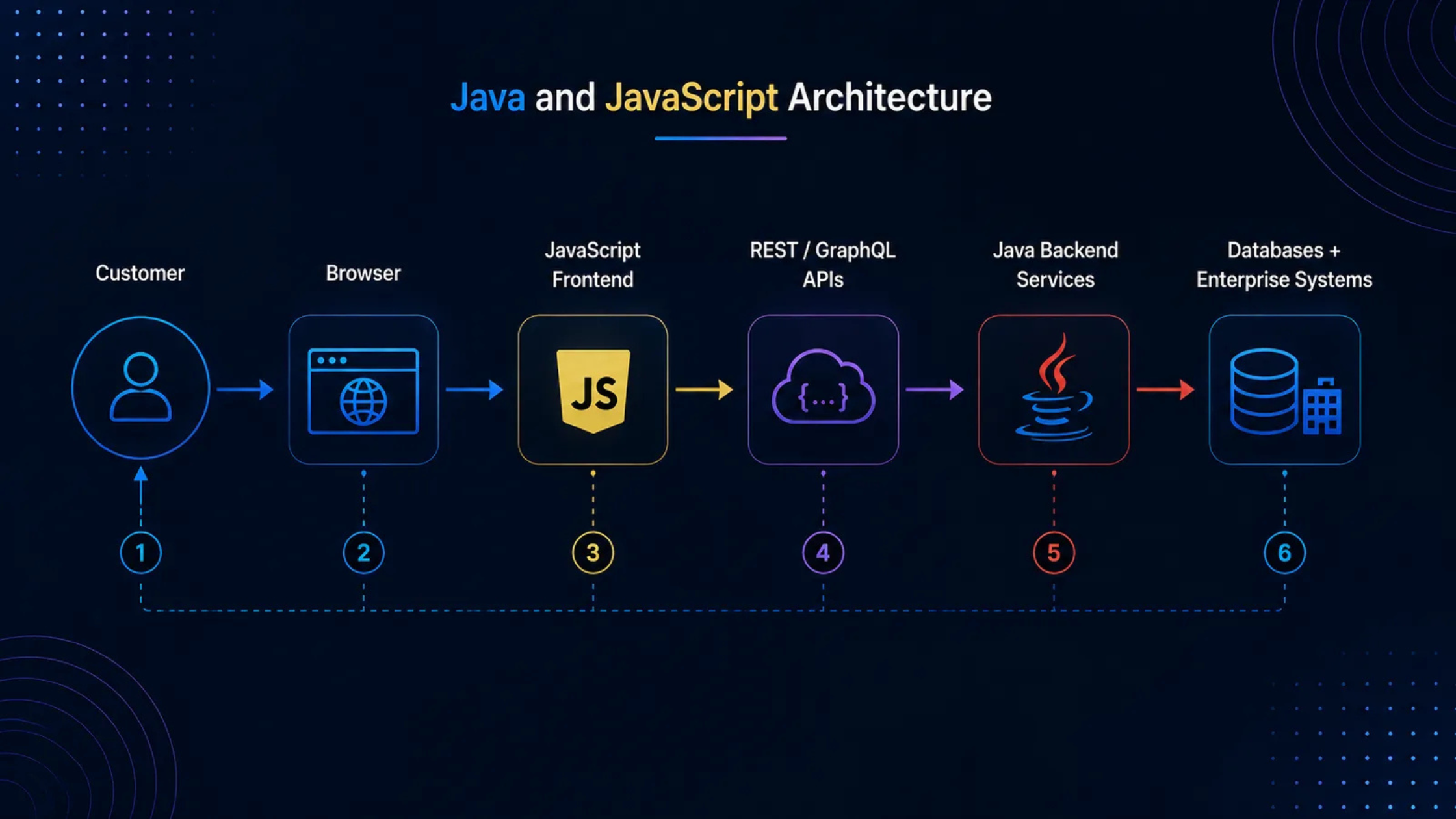
Browser → JavaScript frontend → API → Java backend → Database
This architecture is common in enterprise software. A modern application could therefore use both languages without either replacing the other.
Java vs JavaScript for Backend Development
Both languages can power backend systems, but they have different strengths.
Java has a particularly strong history in enterprise backend development. Its mature ecosystem, static type system, JVM, concurrency capabilities, tooling, and extensive libraries make it suitable for large systems.
JavaScript became a major backend option with the rise of Node.js and similar runtimes. Its asynchronous programming model can be particularly convenient for applications handling many I/O-bound operations such as API requests, database calls, and network communication.
Request
↓
JavaScript application
↓
Database/API call
↓
Response
Java can also handle these workloads extremely well, but its development model and concurrency architecture differ. The choice therefore depends heavily on the application rather than a simplistic “Java is faster” or “JavaScript is faster” argument.
Concurrency: A Major Technical Difference
Concurrency is one of the areas where the two ecosystems take notably different approaches.
Java has traditionally provided a thread-based concurrency model and has extensive APIs for managing concurrent tasks. Modern Java also includes virtual threads, which provide a lightweight approach to handling large numbers of concurrent tasks.
JavaScript’s common server-side model is different.
Node.js typically uses an event loop and asynchronous I/O. Instead of creating a traditional thread for every request, applications can continue processing other work while waiting for I/O operations such as network or database requests.
This makes JavaScript particularly effective for many I/O-heavy workloads. However, there is an important limitation.
A CPU-intensive task running directly on the main Node.js event loop can block other work. That’s why JavaScript applications may use worker threads or separate processes for CPU-heavy workloads.
So:
Java: strong built-in concurrency and parallel execution capabilities.
JavaScript: event-driven asynchronous programming with additional mechanisms available for parallel CPU work.
Neither model is universally better. They solve different problems.
Java vs JavaScript: Performance
Performance comparisons between Java and JavaScript are often oversimplified. There isn’t a single benchmark that can answer which language is “faster.”
Performance depends on:
- Application architecture
- Runtime implementation
- Algorithms
- Database performance
- Network latency
- Memory usage
- Concurrency model
- Garbage collection
- Frameworks and libraries
- Hardware
- Workload characteristics
Java’s JVM has sophisticated optimization capabilities, including JIT compilation and garbage collection. Oracle describes HotSpot as dynamically identifying performance-critical code and optimizing it during execution.
Modern JavaScript engines are also highly optimized. For a typical web application, the difference in language-level performance may be less important than architectural decisions.
For example, reducing unnecessary database queries can produce a far larger performance improvement than switching from one programming language to another.
Java vs JavaScript for Enterprise Applications
Java has a particularly strong position in enterprise software. Large organizations often value:
- Strong type checking
- Mature tooling
- Long-term maintainability
- Robust concurrency
- Extensive libraries
- Security tooling
- Large developer ecosystems
- Predictable application architecture
Java’s portability through the JVM is also a major part of its design.
JavaScript can absolutely be used for enterprise systems as well, especially when organizations standardize on TypeScript for stronger static typing while retaining the JavaScript ecosystem.
However, if you’re working on an organization with decades of Java infrastructure, Java expertise, established frameworks, and existing JVM-based systems, continuing with Java can have significant operational advantages.
Java vs JavaScript for Mobile Development
Historically, Java played an enormous role in Android development.
Today, Android development has evolved substantially, with Kotlin becoming a major language in the ecosystem. Java remains relevant in existing Android codebases and the broader JVM ecosystem, but developers starting a new Android application should evaluate Kotlin alongside Java rather than assuming Java is automatically the default choice.
JavaScript can also be used for mobile applications through technologies such as React Native and other cross-platform frameworks.
The important distinction is that JavaScript isn’t normally running as the native Android language in the same way Java or Kotlin does. Instead, frameworks provide a bridge or runtime architecture for building mobile experiences with JavaScript-based tooling.
Java vs JavaScript: Ecosystem and Frameworks
Both ecosystems are enormous, but they have developed around different types of applications.
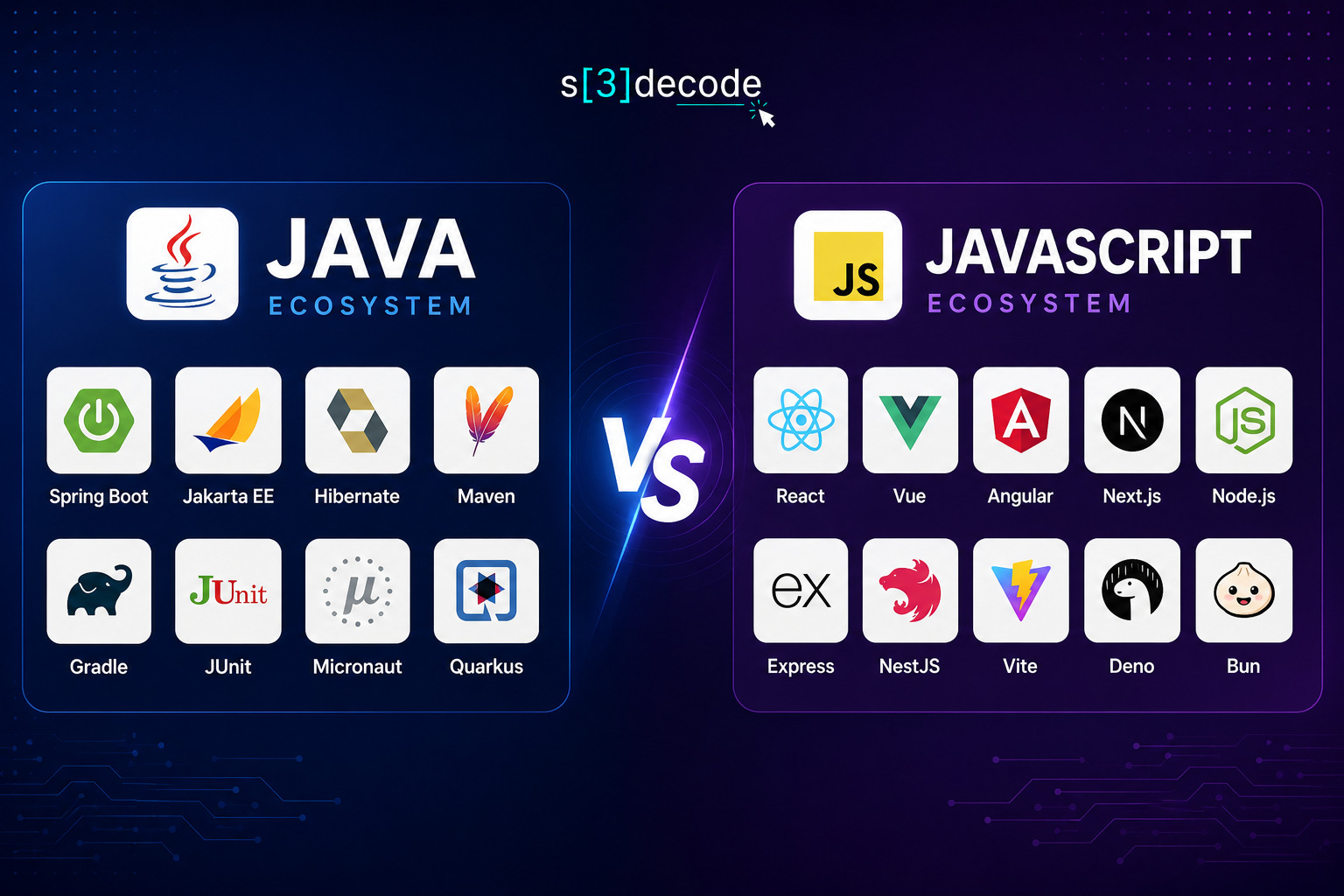
The ecosystem covers both frontend and backend development.
One important difference is that JavaScript’s ecosystem is closely connected to the web platform itself.
The browser is effectively a JavaScript runtime environment with access to web APIs, while Java applications generally run through the JVM or other Java runtime environments.
Java vs JavaScript: A Real-World Architecture Example
Imagine you’re building an online banking platform.
The customer opens the website and interacts with the interface.
JavaScript could handle:
- Account dashboard interactions
- Form validation
- Dynamic UI updates
- Data visualization
- API requests
- Notifications
- Client-side state
Meanwhile, Java could power backend services responsible for:
- Account management
- Transaction processing
- Authentication
- Business rules
- Database operations
- Risk systems
- Enterprise integrations
The architecture could look like:
Java vs JavaScript: Which Should You Choose?
The right choice depends on what you’re building.
| Your Goal | Better Starting Point |
|---|---|
| Interactive website | JavaScript |
| Frontend web application | JavaScript |
| Full-stack web application | JavaScript or Java + JavaScript |
| Enterprise backend | Java |
| Large-scale backend systems | Java |
| REST APIs | Both |
| Real-time web application | JavaScript is often convenient |
| Complex enterprise software | Java |
| Existing JVM infrastructure | Java |
| Browser-based functionality | JavaScript |
| Cross-platform web development | JavaScript |
| Data-intensive enterprise systems | Java can be a strong fit |
Modern development often combines multiple languages and technologies.
Java vs JavaScript: The Key Tradeoff
The biggest difference isn’t simply syntax. It’s how each language approaches software development.
Java gives developers a more structured environment with static typing, a class-based model, a powerful runtime, and extensive tooling. This can increase development discipline and predictability in large systems, although it can also introduce more complexity upfront.
JavaScript provides greater runtime flexibility and is deeply integrated with the web platform. That makes it extremely productive for interactive applications, but its dynamic nature requires developers to understand runtime behavior carefully.
In other words:
Java generally emphasizes structure, type safety, portability, and large-scale application engineering.
JavaScript emphasizes flexibility, web integration, asynchronous programming, and broad application reach.
Neither philosophy is inherently superior. The right choice depends on the problem you’re solving.
Common Misconceptions About Java and JavaScript
“JavaScript is a simpler version of Java.” – No.
JavaScript has its own language specification, runtime model, type system, object model, and ecosystem. MDN explicitly states that JavaScript is not “Interpreted Java.”
“JavaScript can only be used for websites.” – No
JavaScript runs in browsers as well as server-side and other environments such as Node.js, Deno, and Bun.
“Java is only for old enterprise applications.” – No
The language continues to receive new releases and ongoing improvements. Java 26 was released in March 2026, while Oracle continues to develop and enhance the JVM and Java platform.
“Custom JavaScript is always faster than Java.” – No
Performance depends on the workload and implementation. A poorly designed JavaScript application can be slower than a well-engineered Java system, and the reverse can also happen.
Java vs JavaScript: Final Verdict
So, what is the difference between Java and JavaScript?
Java is a statically typed, class-based programming language built around the JVM and particularly strong for backend, enterprise, and large-scale application development.
JavaScript is a dynamically typed, multi-paradigm language that became fundamental to browser development and has expanded into backend, mobile, desktop, serverless, and other environments.
The names may look similar, but the languages are fundamentally different.
If you’re building a web interface, JavaScript is usually the obvious choice. For a large enterprise backend, Java can be an excellent fit. When developing a modern full-stack application, you don’t necessarily have to choose only one. A Java backend combined with a JavaScript frontend is a perfectly viable architecture.
When choosing a language to learn in 2026, don’t base your decision only on which language is “more powerful.” Instead, consider the type of software you want to build and the kind of developer you want to become.